


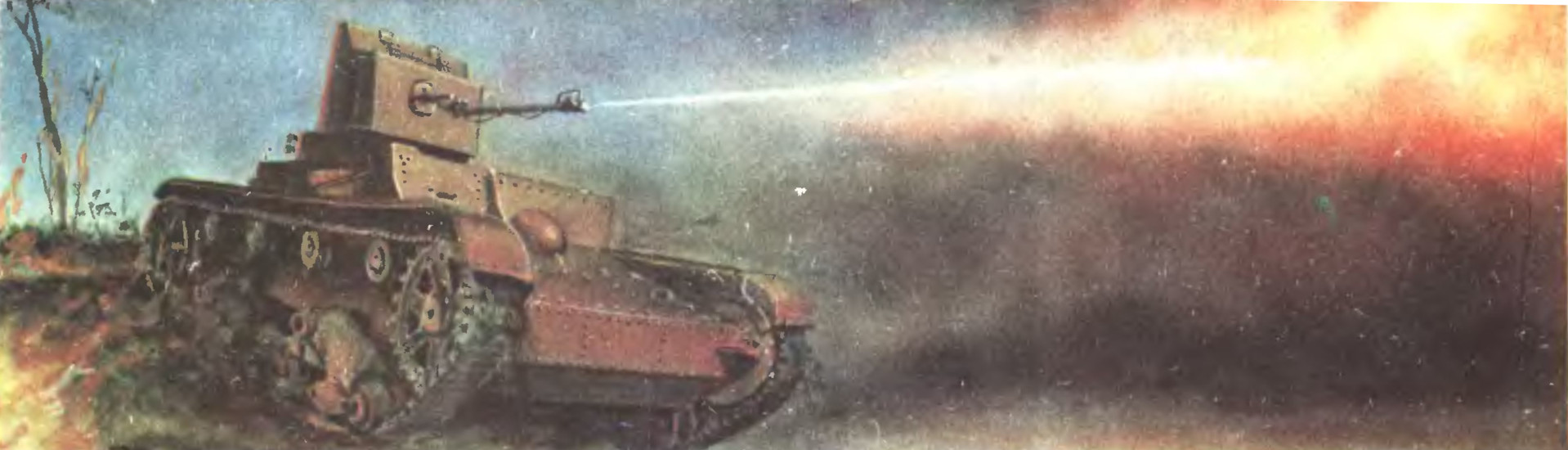
One could say that the flamethrower is almost the same age as the tank: it began to be used in battles just a year before tanks had their combat debut.
It should be noted: first used by the Germans in large quantities on July 30, 1915, against the British, they achieved, perhaps, a greater moral effect than "armored vehicles." The fact is that the flamethrower proved to be very important in trench warfare for uncovering pillboxes, shelters, etc. And since it was not a cumbersome weapon, as expected, it was later installed on tanks. However, this did not happen soon—it was in 1933. At that time, an OT-26 flamethrower tank was built in our country based on the T-26 tank.
In combat, such vehicles, or tankettes (SUA/33), as they were called, were first used by the Italians in 1936 during their war of aggression against Ethiopia.
Flamethrower tanks (abbreviated as OT) were also widely used in World War II. In addition to the Red Army, similar machines were part of the American, British, German, and Italian armies' arsenals.
A flamethrower can be the main or auxiliary armament of a tank. In the first case, all equipment (including the nozzle, tanks with flame mixture, compressed air cylinders, ignition system, etc.) is installed in the machine instead of the gun, or the gun is replaced by a smaller-caliber artillery system. Additionally, it carries and stores ammunition. A flamethrower installed on the tank's turret can provide circular fire. Such was our OT-26, in which the radial placement of the flame mixture tank removed one turret. Recall that in 1931, our T-26, the German flamethrower T-111, and the Italian SUA/33 and SUA/35 were all dual-turreted. However, they proved ineffective in battle: the flamethrower is a close-range weapon (its range is several dozen meters), and thus it is powerless against tanks and anti-tank artillery. These machines are needed to support line (regular) tanks. In the second case, OTs with significant armament were used under the same conditions as line tanks. However, the flamethrower, forcibly installed not in the turret but in the frontal plate or on the hull roof, could not provide circular fire. The flame mixture supply was also small. The British and Italians tried to rectify the situation by placing the mixture tank in a special armored trailer. Thus, the "Churchill Crocodile" tank (1942) was born. The USA made a construction advantage: reducing the tank's fire hazard. However, the benefit also brought many drawbacks: reduced maneuverability and vehicle passability, and the flamethrower system became more complex.
In the 1930s, besides the OT-26, we built the OT-130 flamethrower tank based on the single-turret T-26. Instead of a gun, it had a flamethrower. The machine retained the paired machine gun and equipment for creating smoke screens. The OT-26 and OT-130 were equipped with pneumatic flamethrowers, as the flammable liquid was expelled through the nozzle by compressed air at a pressure of 25 (in the OT-26) or 35 (in the OT-130) atmospheres. The liquid's range reached 50 meters, and the flame mixture (fuel oil-kerosene) volume was 360 liters, which was quickly expended in 40 one-second shots (OT-130).
Flamethrower tanks based on the T-26 performed excellently in battles at Lake Khasan (1938) and a year later on the Khalkhin-Gol River. During the war on the Karelian Isthmus in 1939-1940, several battalions and separate OT companies participated in operations. In 1941, our designers created the ATO-41 automatic powder flamethrower. It used powder charges from the 45-mm gun cartridge. When the charge detonated, powder gases compressed the liquid flame mixture, which was expelled from the cylinder. The "flaming liquid" could be fired in single shots or sequentially in 4-5 shots thanks to an automatic reloading mechanism with compressed air. In 1942, an improved ATO-42 flamethrower with double the rate of fire was introduced. The range of both flamethrowers was 60-70 meters with a liquid mixture and up to 100 meters with a viscous mixture. No other army in the world had such flamethrowers. The ATO-41 was installed instead of the frontal machine gun in the T-34 (designated T-034), and the ATO-42 in the T-34-85 (designated T-034-75).
In 1942, the heavy flamethrower tank KV-8 with the ATO-41 in the turret was also produced, but with the 76-mm gun replaced by a 45-mm gun. The flame mixture supply was 100 liters for the T-034, 200 liters for the T-034-85, and 570 liters for the KV-8. These vehicles were used in flamethrower tank battalions in the Red Army until the end of the war. In the offensive, they followed the line tanks, and when approaching the target (fortifications, buildings, etc.), they moved forward to attack.
In Great Britain, besides the already mentioned "Churchill Crocodile" (based on the "Churchill VII"), there was also the "Wasp" flamethrower armored personnel carrier. Both machines were supplied to the USSR in small quantities. They had pneumatic flamethrowers (operating on compressed nitrogen). The range of the viscous mixture was 135-150 meters. The "Crocodile" had a flame mixture supply of 1800 liters, which could be expelled in 60 shots. In case of necessity, the "Churchill" trailer could be detached by detonating a charge in the coupling mechanism. The "Crocodiles" remained in the British army's arsenal after the war and participated in the imperialist war against the Korean people.
American pneumatic flamethrowers (preserving external armament) were installed on the M3A1, M5A1, LVT(A)1, and LVT(A)2 tanks and amphibious vehicles. The viscous mixture was expelled at a range of 90 meters. After the war, the American army received the M67 tank, based on the M48 medium tank. The flamethrower replaced the gun in the turret. The weapon's range was 190, and the preliminary flame mixture even reached 270 meters.
The Germans first used flamethrower tanks in June 1941 on the Soviet front. These machines, based on the light T-11 tank modifications O and E, had small turrets with machine guns. Two flamethrower nozzles were installed on the front corners of the hull. The flame mixture supply (coal tar) was 320 liters, with a range of 40 meters. Due to their weak armor, these machines suffered heavy losses and were soon withdrawn from service.
In 1943, factories produced 100 OTs based on the T-111 medium tank modification M. This vehicle had a flamethrower installed in the turret instead of the 50-mm gun. The mixture supply was 1000 liters. The vehicle had two machine guns and six mortars for firing smoke shells.
The Italians produced two types of flamethrower vehicles based on the SUA/33 and SUA/35 tankettes, used in battles in the North European theater in 1940-1941 and on the Soviet-German front in 1942. The pneumatic flamethrower was installed instead of the machine gun. The tanks were placed either on the vehicle itself or in a wheeled trailer. The range was up to 60 meters.
As we can see, the flamethrower began to be used as a tank weapon. After the war, this idea continued to develop.
The cover image shows the Soviet OT-26 flamethrower tank. Combat weight - 9 tons. Crew - 2 people. Armament - one flamethrower, one 7.62-mm machine gun. Armor thickness: front, side of the hull, and turret - 15 mm. Engine - T-26, 90 hp. Road speed - 30 km/h. Road range - 150 km.
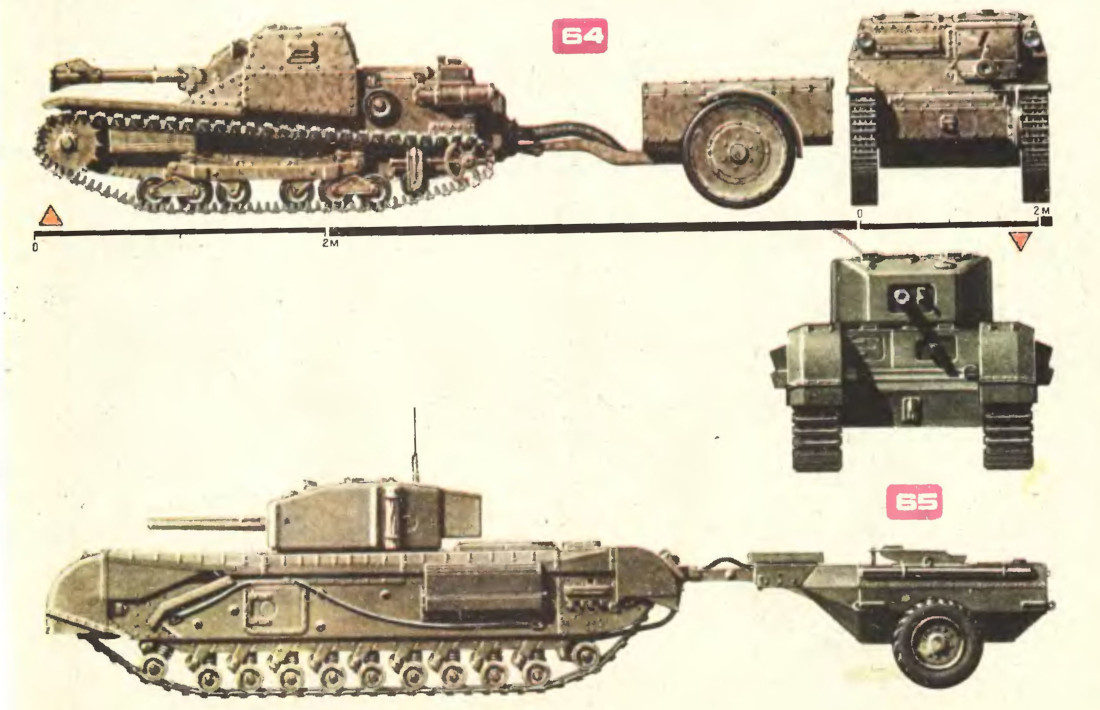
Fig. 64. Italian flamethrower tankette. Combat weight - 3.3 tons. Crew - 2 people. Armament - one flamethrower. Armor thickness: front of the hull - 13 mm, side - 8 mm. Engine - "Fiat," 40 hp. Road speed - 42 km/h. Road range - 150 km.
Fig. 65. British heavy flamethrower tank "Churchill Crocodile" ("Churchill VII"). Combat weight - 45 tons. Crew - 5 people. Armament - one 70-mm gun, two 7.92-mm machine guns, one 7.7-mm anti-aircraft machine gun, one flamethrower. Armor thickness: front of the hull - 152 mm, side - 95 mm, turret - 152 mm. Engine - "Bedford," 350 hp. Road speed - 20 km/h. Road range - 200 km.