


We have already talked about tanks that had both separate propulsion systems — wheeled and tracked (see "TM" No. 10 for 1979).
But these machines were distinguished by the complexity of their design, making them difficult to operate and maintain. Therefore, they did not go into mass production.
American designer Walter Christie found another technical solution that allowed for increased operational mobility of tanks (in other words, speed when moving on roads). Christie increased the diameter of the road wheels (the front two of which were steerable) to the size of automobile wheels, and made the track removable. Now, when moving with the tracks removed, the tractive effort was transmitted from the drive wheel to the rear pair of road wheels, which served as drive wheels, using a Gall chain.
Christie built his first wheeled-tracked machine in 1919. However, his idea was fully realized in the models of 1928 and especially 1931. The designer himself called it the "tank of 1940". It had four road wheels on each side. In pursuit of speed, the inventor equipped it with an aircraft engine, which provided it with unrivaled specific power (more than 40 hp/t) and a road speed on wheels of up to 113 km/h. The tank's weight was 7-9 tons.
The machines of this American engineer, built in 1931, were tested by the country's army but were not adopted for service. Specialists believed that at high speeds they were very difficult to control, and the tank's armor was insufficient. However, Christie's ideas had a significant impact on the subsequent development of "ironclads". Many of his design solutions are still used today: the sloped frontal plate, large-diameter road wheels with individual suspension, and the placement of resilient elements inside the hull, and the compact placement of the engine in the rear of the machine.
The idea of a wheeled-tracked tank with a chassis designed by Christie was implemented in our country. The first such model, designated BT-2, was accepted into service in absentia on May 23, 1931 (even before the prototype was manufactured). Production began three months later, and three machines participated in the military parade on November 7 of that year.
On the BT-2, a gear ("guitar") was used instead of a chain transmission when moving on wheels. To change the propulsion system, the crew needed only 30 minutes.
The new design suffered from many "teething problems": aircraft engines started poorly and often overheated. The BT-2 was produced until 1933 (with several weapon variants). These machines were well-received by the Red Army soldiers due to their excellent speed characteristics.
Soviet designers worked on further improving the combat properties of the tank. As a result, in 1933, the BT-5 appeared, armed with a 45-mm gun (model 1932) and a coaxial machine gun. The machine was equipped with a domestically produced engine, an improved turret shape, and reinforced chassis parts. Command BT-5s had radio stations with rail antennas. This, by the way, served them poorly in combat: the enemy, seeing these tanks from afar, tried to disable them first. Subsequently, the antenna was replaced with a whip antenna.
In 1935, the BT-7 tank began to enter the Red Army. It was equipped with an improved engine, a newly designed main clutch, and floating band brakes, which significantly improved its running qualities. The thickness of the armor and range were also increased. Three years after the start of production, the BT-7 began to be produced with conical turrets to increase bullet resistance. Two years before the start of the Great Patriotic War, the BT-7M modification was equipped with a specially designed V-2 diesel engine instead of the outdated M-17T, which had previously been used in aviation and had been discontinued. The tank's speed increased to 62-86 km/h, the range to 600/700 km (numerator on tracks, denominator on wheels), and the weight to 14.6 tons.
The production of the BT-7M ceased in the spring of 1940, and it was replaced by the famous T-34, which inherited from its predecessor a number of transmission and chassis elements and the engine.
BT series machines were the main tanks of independent mechanized and large tank units of the Red Army, and like all light tanks of the 1930s, they were "clad" in bulletproof armor. Therefore, by the beginning of World War II, they were already outdated. The BT-5 fought in 1938 at Lake Khasan and in Spain in 1936-1938, the BT-7 at Khalkhin Gol and in 1939-1940 on the Karelian Isthmus. The machines were also useful at the beginning of the Great Patriotic War.
In 1985, a wheeled-tracked variant of the medium tank T-28, called the T-29, was created. The experimental T-29 machine had the hull, engine, and armament from the T-28, but the chassis was completely new: eight large-diameter road wheels, with three pairs being drive wheels, unlike the BT. Thanks to special synchronizers, the tank could move with one track. However, the T-29 proved to be complicated to operate and did not go into series production. Nevertheless, it was an important stage in Soviet tank development.
In the same 1935, designers attempted to create a light wheeled-tracked tank intended to replace our main tank, the T-26. It was called the T-46 and had eight large-diameter road wheels (two pairs of drive wheels). With a weight of 15 tons, its armament and armor were no different from the T-26 or BT, and due to its complexity, it did not go into production.
The cover image shows the Soviet medium tank T-29. Combat weight — 28.5 tons. Crew — 5 people. Armament — one 76-mm gun, four 7.62-mm DT machine guns. Armor thickness: front of hull — 30 mm, side and turret — 20 mm. Engine — M17L gasoline, 500 hp. Road speed — 56 km/h on tracks, 80 km/h on wheels. Range on the road — 220 km.
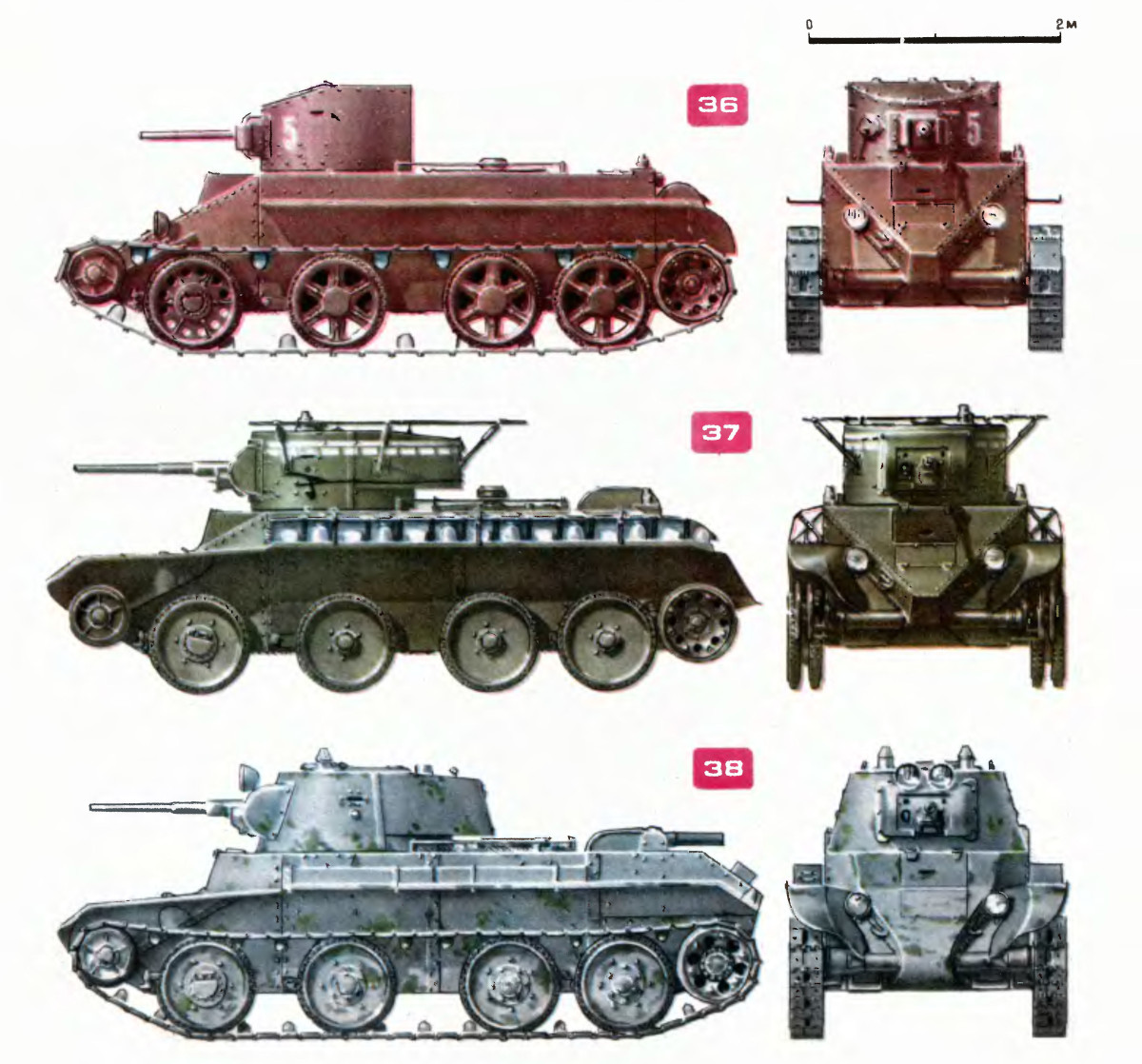
Fig. 36. Soviet light tank BT-2. Combat weight — 11 tons. Crew — 3 people. Armament — one 37-mm gun, one 7.62-mm DT machine gun. Armor thickness — front, side of hull and turret — 13 mm. Engine — "Liberty" aircraft, 400 hp. Road speed — 52 km/h on tracks, 72 km/h on wheels. Range on the road — 200 and 300 km, respectively.
Fig. 37. Soviet light tank BT-5. Combat weight — 11.5 tons. Crew — 3 people. Armament — one 45-mm gun, one 7.62-mm DT machine gun. Armor thickness — front, side of hull and turret — 13 mm. Engine — M-5 aircraft, 400 hp. Road speed — 52 km/h on tracks, 72 km/h on wheels. Range on the road — 200 and 300 km, respectively.
Fig. 38. Soviet light tank BT-7. Combat weight — 13.8 tons. Crew — 3 people. Armament — one 45-mm gun model 1932, one-two 7.62-mm machine guns. Armor thickness: front of hull — 20 mm, side — 13 mm, turret — 15 mm. Engine — M17T gasoline, 400 hp. Road speed — 52-73 km/h. Range on the road — 350-500 km (with additional tanks).
```