


Even during the time of the first demonstration flights of Cierva autogyros in America, which after Spain and England became, as it were, the third homeland of aircraft of this type, the famous Thomas Alva Edison remarked: “These machines meet the needs of aviation and the demands of those people who have always wanted to fly but were afraid. It seems to me that this is the greatest step forward since the time of the Wright brothers.”
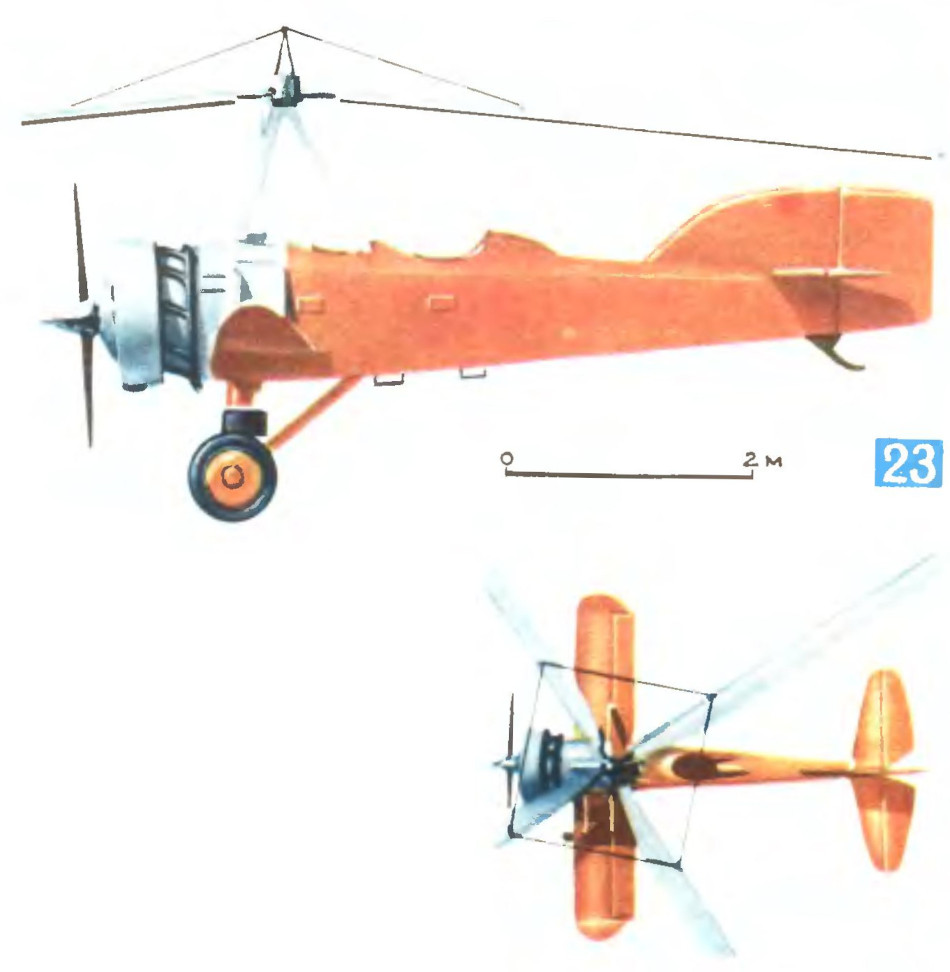 |
| 23. TsAGI A-4 autogyro (USSR, 1936). Engine — M-26, 300 hp. Rotor diameter — 13 m. Number of blades — 4. Rotational speed — 150 rpm. Takeoff weight — 1320 kg. Empty weight — 1020 kg. Maximum speed — 176 km/h. Minimum speed — 50 km/h. Ceiling — 4100 m. |
Perhaps Edison, himself not unfamiliar in the past with aviation and, in particular, helicopter invention, quite accurately expressed the shift that occurred in the minds of specialists and the general public after the spectacular autogyro flights in Europe and the New World. Indeed, why struggle with capricious, unstable helicopters when there already exists a rotary-wing machine capable of taking off from a tiny “patch,” not inferior to an airplane in speed, and obedient to any even moderately trained pilot? So why spend considerable funds, conduct troublesome experiments with lifting rotors, and consume scarce materials? Just to rise a meter or a meter and a half above the ground and, at best, trace a timid figure-eight within the airfield boundaries?
By 1933, more than 130 autogyros had already taken to the skies of Europe and America. They carried tens of thousands of passengers, logged 35,000 flight hours, and covered a total distance of 4 million kilometers. In that same year, 1933, Cierva, who had settled in England, created the C-30 autogyro, which became a classic design. It was reproduced many times by firms in almost all aviation powers. Three years later, the Spaniard equipped the C-30 with a system for jump (no-run) takeoff. Many autogyros of that era made do with takeoff sites of minimal size, since the lifting rotor was spun up not by the oncoming airflow but by its own engine. During takeoff, the engine drove not only the tractor propeller but also—through a special clutch—the lifting rotor. If the rotor accelerated to the point where aerodynamic forces drove it faster than the engine did, simple automation engaged and all the engine’s power was transferred to the propeller. And since the rotor was spun up before takeoff, the autogyro (for example, the C-19) lifted off after a run of only 27–28 m. Cierva once again brilliantly demonstrated his inventive abilities by creating for the C-30 a mechanism to transmit the full engine power to the rotor during takeoff.
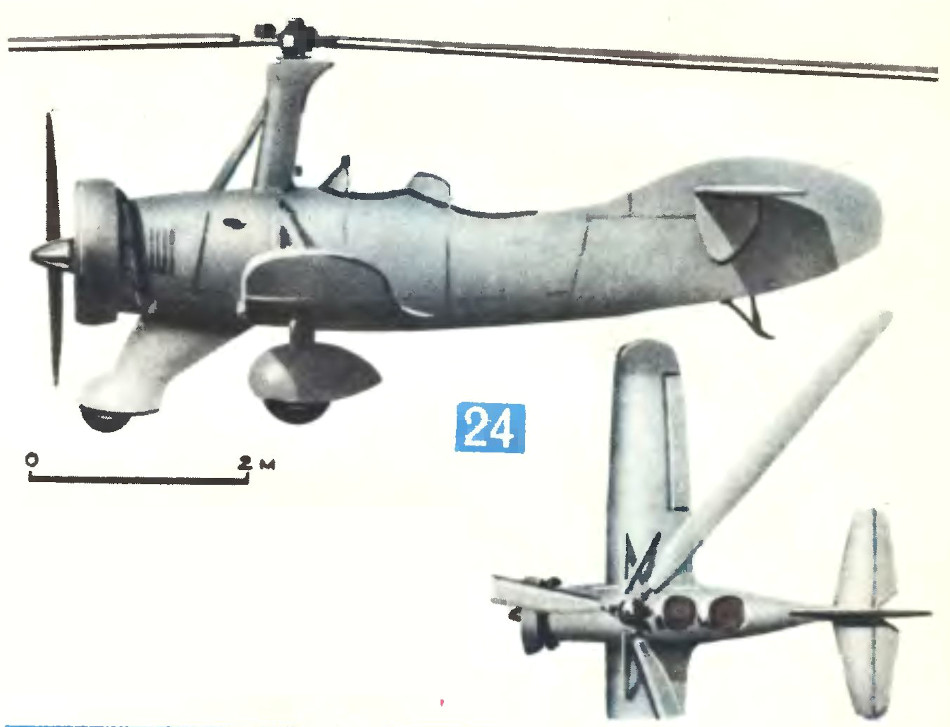 |
| 24. Two-seat TsAGI A-7 autogyro (USSR, 1934). Engine — M-22, 480 hp. Rotor diameter — 15.18 m. Number of blades — 3. Takeoff weight — 2056 kg. Empty weight — 1300 kg. Maximum speed — 210 km/h. Minimum speed — 46 km/h. Ceiling — 4800 m. |
Before spinning up the rotor, its blades were set to a position corresponding to zero lift. Then the “unloaded” rotor was accelerated to 1.5–1.6 times the speed required for flight. The pilot quickly shifted the blades to the flight position, the autogyro leapt upward, and the propeller immediately pulled the ready-to-settle machine forward. From then on, the rotor freely autorotated under the influence of the oncoming airflow.
Having once inherited from the airplane a wing and elevators and rudder, the autogyro dispensed with these elements that were unnecessary for it. For precisely at low flight speeds, in regimes where its advantages over airplanes were most evident, ailerons and the rudder and elevator ceased to function. The machines began to be equipped with a lifting rotor capable of tilting in any direction. This occurred as follows: by acting on the control stick, the pilot tilted the axis of the rotor hub in the desired direction.
On the experimental AR III Hafner autogyro, the control problem was solved entirely “in a helicopter manner.” The rotor tilted due to cyclic variation of the blade pitch—using a mechanism similar to Yuryev’s swashplate.
Soviet designers also showed great interest in autogyros. After the first KASKRs, they built original machines and closely studied the best examples produced abroad. In England, at a small flight school attached to Cierva’s firm, A. M. Cheremukhin and test pilot S. A. Korzinshchikov trained on the wingless C-30 autogyro. They returned home bringing with them a specimen of this machine, purchased for detailed experimentation.
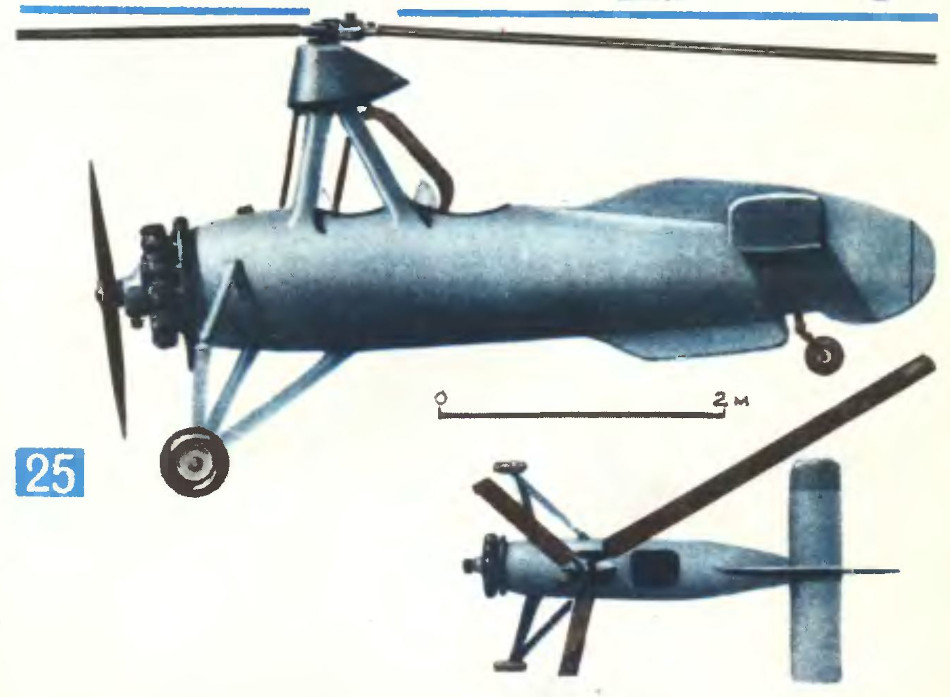 |
| 25. Wingless Cierva C-30 autogyro (England, 1933). |
Work on winged autogyros also proceeded at full pace in our country. In 1934, the TsAGI A-4, created by the Department of Special Designs of the renowned institute under the general supervision of A. M. Cheremukhin, was produced in a small series. All aerodynamic research and calculations for this machine were directed by M. L. Mil, the future designer of world-famous helicopters.
In the same year, the TsAGI A-7 autogyro, designed by N. I. Kamov, later also a famous chief designer, took to the air for the first time. The A-7 was created for the army as a short-range reconnaissance and artillery fire-spotting aircraft. The machine was equipped with a tricycle landing gear and blades of the rotor and wing panels that folded on the ground. For the first time in world practice, defensive armament was installed on an autogyro: a forward machine-gun mount firing through the tractor propeller and a twin machine gun on a turret in the observer’s cockpit. In 1937, the machine was improved. Under the designation A-7 bis, it demonstrated excellent flight performance, and in 1938 it was planned for use in evacuating the Papanin expedition members from a drifting ice floe. One A-7 of this series successfully operated in the Tien Shan mountains in the spring of 1941, and when the Great Patriotic War began, several autogyros operated in combat conditions near Smolensk.
Very high flight performance for its time was shown by the wingless TsAGI A-12 autogyro, which took to the air in May 1936 piloted by A. P. Chernavsky. And although a year later the A-12 suffered a crash due to material fatigue of the blade spar, the machine managed to demonstrate a speed of 245 km/h and a flight altitude of 5570 m.
The last Soviet wingless autogyro designed in the 1930s was the AK. It had a swashplate for direct control of the lifting rotor and a device for jump takeoff. The outbreak of war prevented the construction of this promising machine. However, the experience accumulated by Soviet and foreign designers in creating rotary-wing aircraft of this type helped them build successful helicopter designs, which proved far more viable than their relatives—the autogyros.
On the cover: experimental TsAGI A-12 autogyro (USSR, 1936). Engine — Wright Cyclone, 640 hp. Rotor diameter — 14 m. Number of blades — 3. Rotational speed — 160–260 rpm. Takeoff weight — 1687 kg. Empty weight — 1343 kg. Maximum achieved flight speed — 245 km/h. Minimum speed — 52 km/h. Ceiling — 5570 m. Rate of climb at ground level — 11.1 m/s.