


On September 28, 1934, the characteristic flapping sound that had long been heard over the Ukhtomsky airfield was suddenly replaced by the sharp crack of breaking metal, followed by the rattling, chaotic noise of an unbalanced main rotor.
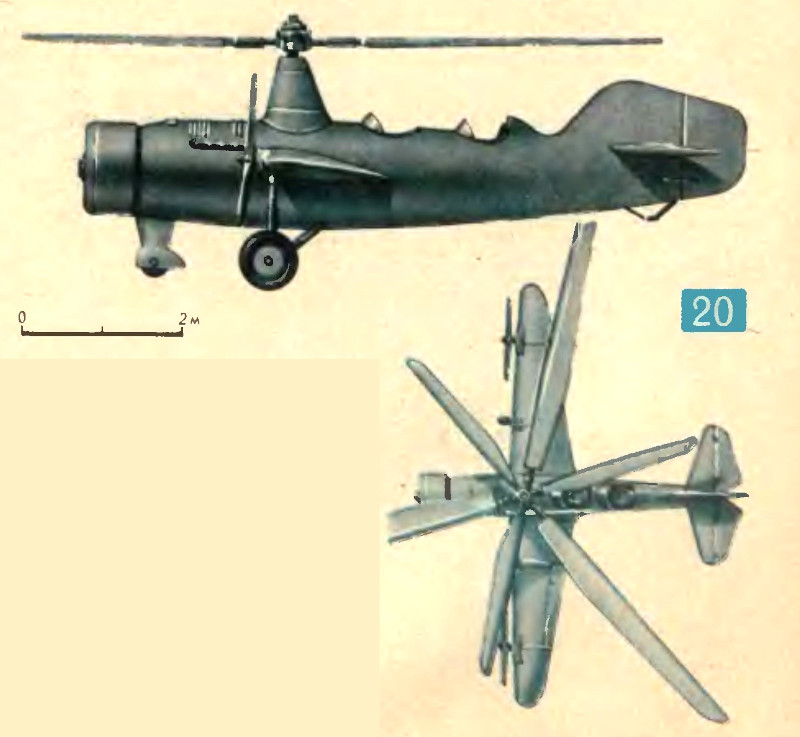 |
| 20. TsAGI helicopter 11-EA (USSR, 1936). Its specifications practically did not differ from those of the improved 11-EA PV version. Flight tests were not conducted.. |
To the horror of the few who were watching the flight of the rotorcraft, it began to shake violently and descend steeply, almost falling. Once again, flying fortune showed mercy to a man who often tempted fate: this time as well, Alexey Mikhailovich Cheremukhin—one of the creators and the permanent pilot of the first Soviet helicopters—remained unharmed, which could not be said of the TsAGI 5-EA, the new rotorcraft of the Special Structures Department (OOK) of TsAGI.
Impressive as the successes of the TsAGI 1-EA were—having far exceeded all officially registered altitude records—the designers realized that the machine lacked sufficient stability, an inherent drawback of aircraft with rotor blades rigidly attached to the hub. After building its modified version, the TsAGI 3-EA, engineers tested it while tethered and then set about creating a new machine with a fundamentally different rotor.
According to the concept of the idea’s author, I. R. Bratukhin, it was to be a combination of two three-bladed rotors mounted on a single axis: a large main rotor with a diameter of 12 m предназначенный solely to generate lift, and a comparatively small rotor (diameter 7.8 m), whose blades, attached to the hub between the long blades, were intended for control via the swashplate. Initially, the attachment of the large main-rotor blades was provided only with horizontal hinges, allowing the blades to perform flapping motion in the vertical plane. And although the very first flights of the TsAGI 5-EA revealed the serious danger of the single-hinge scheme—cracks were found at the blade roots—the designers did not rush to grant the blades freedom of motion in the horizontal plane as well. The action of so-called Coriolis forces, arising because a blade participates, as it were, in two motions (rotation and flapping about a horizontal hinge), led to the accident that nearly cost Cheremukhin his life.
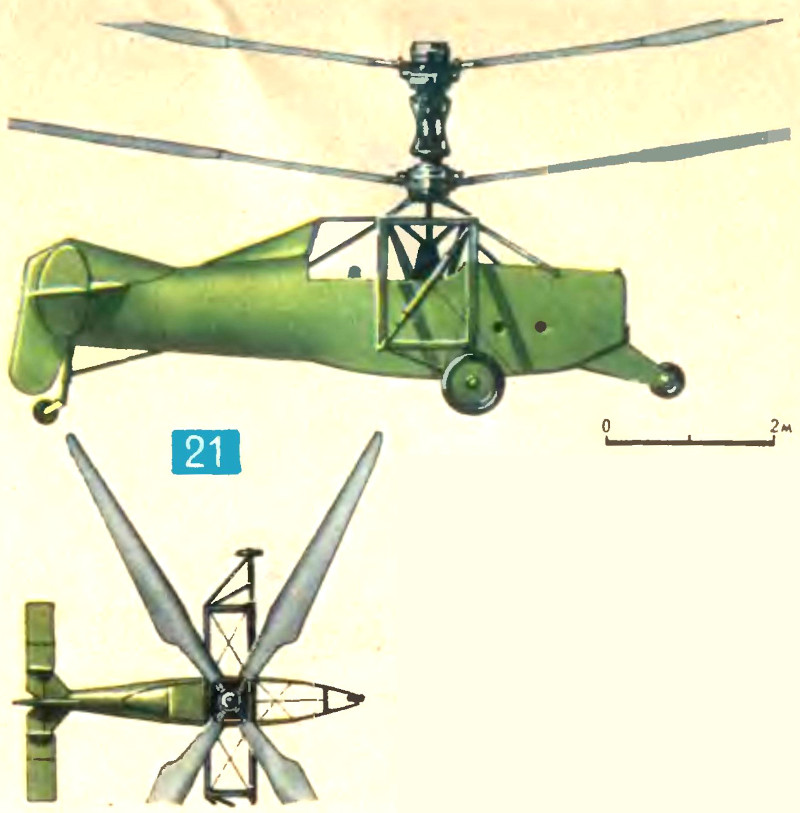 |
| 21. “Breguet–Dorand” helicopter (France, 1935). Engine — Hispano-Suiza, 300 hp. Main rotor diameter — 15.89 m. Rotational speed — 132 rpm. Takeoff weight — 1950 kg. Structural weight — 1430 kg. In 1936 it set world helicopter records: speed over 20 km — 44.7 km/h, maximum altitude — 158 m, endurance — 1 h 02 min 50 s, distance over a closed circuit — 44 km. |
The badly damaged helicopter was restored, and—most importantly—the blades were allowed to oscillate in the plane of rotation as well. In addition to horizontal hinges, friction dampers and rubber limiters were installed on the hub: the helicopter had no clutch, and during startup, as the rotor spun up, the blade roots came to rest against these elastic shock absorbers. In 1934, under Bratukhin’s leadership, work began on a helicopter of an unprecedented configuration.
Externally, the machine strongly resembled a conventional airplane. However, a powerful liquid-cooled engine drove not a usual tractor propeller, but a large six-bladed main rotor mounted in front of the cockpit, as well as two propellers at the ends of the airplane wing. The transmission and control system linked the main and control rotors in such a way that the share of power consumed by each could be varied at the pilot’s will. In vertical flight modes, the lion’s share of the power was taken by the lifting system, while the small rotors used power only to counteract its reactive torque. By gradually redistributing power to the propellers, the pilot transitioned the machine into horizontal flight. As speed increased, the engine delivered more and more power to the cruise propellers, while the large rotor automatically entered autorotation: the helicopter turned into an autogyro. Before hovering or landing, everything occurred in reverse order.
The unusual configuration, the then-considerable engine power operating in helicopter modes under very demanding conditions with weak radiator airflow, the complexity of the control system—all this generated a number of theoretical and experimental research problems. The difficult task of creating a control rotor with a wide range of pitch variation in flight was brilliantly solved by OOK designer G. I. Solntsev. During ground tests, the helicopter underwent numerous modifications. The airplane wings were replaced by welded tubular trusses; the main-rotor blades became fully metallic; instead of two control rotors, four of smaller diameter were installed, spaced farther from the fuselage…
Flight tests of the machine began only at the beginning of 1940. It was piloted by test engineer D. I. Savelyev, with one of OOK’s leading specialists, V. P. Lapisov, flying as the experimental observer. Only the outbreak of war forced work on this aircraft to be halted. A pity—it demonstrated good controllability and respectable stability, ease of takeoff even at reduced engine speeds, and the reliability of the transmission and other key units.
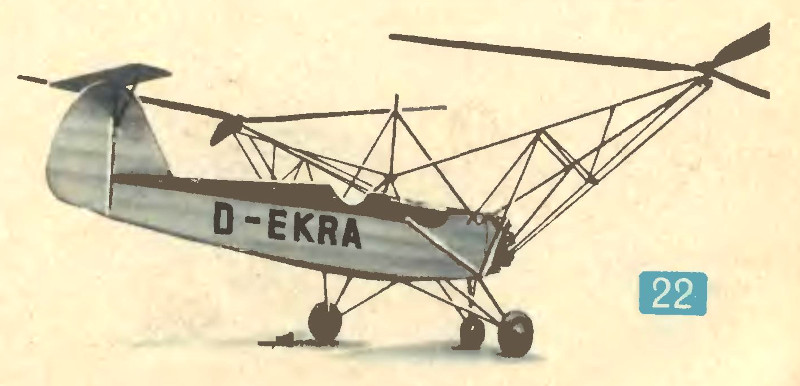 |
| 22. “Focke-Wulf” 61 helicopter (Germany, 1936). Engine — Siemens, 160 hp. Main rotor diameter — 7 m. Set world records: altitude — 3427 m, speed over 20 km — 122.53 km/h, nonstop range — 230.248 km, flight duration with return to takeoff point — 1 h 20 min. |
On the very eve of the war, the old TsAGI 5-EA was rebuilt according to a project by electrical engineer A. G. Iosifyan—later an academician of the Academy of Sciences of the Armenian SSR and one of the creators of the Meteor satellites. Instead of the former two M-2 engines, the machine was equipped with a pair of lightweight electric motors with a total output of 200 hp. The energy source was a mobile ground power station that supplied the aircraft via a flexible armored cable.
Abroad, in the mid to late 1930s, the French and Germans were more successful than others in helicopter construction. Working together with M. Dorand, the well-known aircraft designer L. Breguet created a “gyroplane” which, by today’s standards, was a typical coaxial-rotor helicopter. At the end of November 1935 near Paris, pilot Maurice Claisse lifted the Breguet–Dorand to an altitude of 150 meters and circled the airfield for more than an hour. In the same year, the machine already reached a speed of 100 km/h. As with the first Soviet helicopter, the main rotors served both to generate lift and to control the aircraft.
Encouraged by success, Breguet immediately set about drafting a preliminary design for a giant helicopter weighing 20 tons. According to his estimates, a machine equipped with four 800-hp engines could cover a distance of 6,000 km at a speed of 400 km/h. Such impressive figures are hardly attainable even for modern helicopters.
In Germany, Professor Heinrich Focke built a helicopter of transverse configuration. In July 1937, pilot Rolf reached an altitude of 2,439 m in the Focke and achieved an average speed of 122.5 km/h over a 20 km distance.
On the cover: Experimental TsAGI A-12 autogyro (USSR, 1936). Engine — Wright Cyclone, 640 hp. Main rotor diameter — 14 m. Number of blades — 3. Rotational speed — 160–260 rpm. Takeoff weight — 1687 kg. Empty weight — 1343 kg. Maximum achieved flight speed — 245 km/h. Minimum speed — 52 km/h. Ceiling — 5570 m. Rate of climb at sea level — 11.1 m/s.