


In the history of technology, there are few inventors whose sole authorship is unquestioned by contemporaries and descendants.
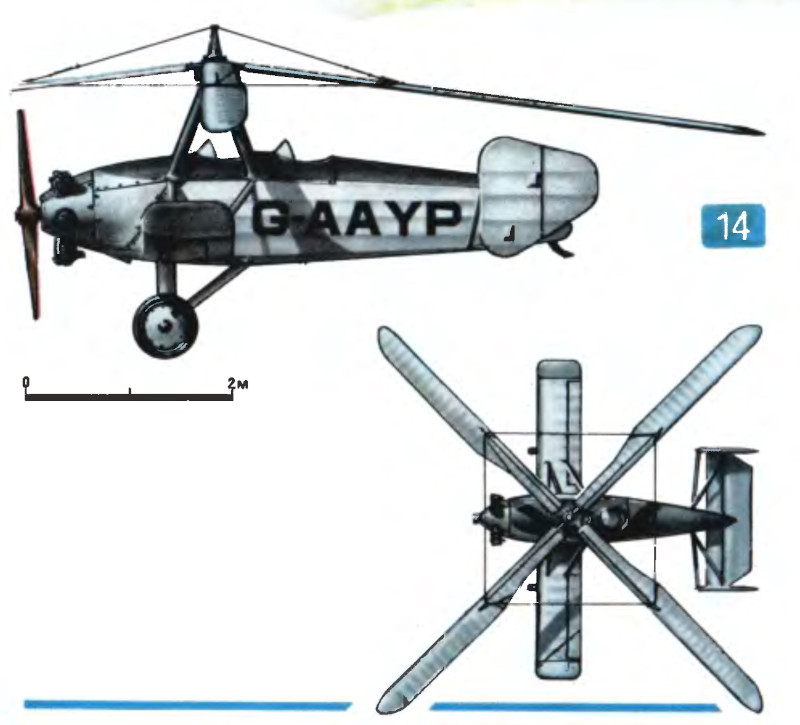 |
| 14. Cierva Autogyro C-19 MkIII (England, 1930). Engine – “Genet”, 80 hp. Rotor diameter – 9.14 m. Takeoff weight – 390 kg. Empty weight – 340 kg. Normal payload – 250 kg. Max speed – 153 km/h. Min speed – 16 km/h. The first autogyro to be produced in series. |
As simple as the idea of a fundamentally new type of flying machine was, it occurred to only one man – the Spanish aircraft designer Juan de la Cierva. His moment of inspiration was preceded by tragedy: in 1919, after building a three-engined biplane for the Spanish Air Fleet, Cierva soon witnessed the destruction of his creation.
The tragic, yet common event for those times shook the designer, although no one blamed him for the disaster. Built to the standard of its era, the airplane shared the same flaw as all of its “peers” – it could not withstand a loss of speed. Trying to “hold up” the stalling machine, the pilot worked the control stick, raising the nose of the aircraft. The already weakened airflow began to strike the wing at too steep, a critical angle of attack, eventually breaking away from the surface; lift suddenly dropped, and the doomed airplane plunged toward the waiting ground.
In the autorotating rotor, spinning under the incoming airstream, Cierva saw a cure for this aeronautical affliction. Let the aircraft, he reasoned, slow its flight to a speed dangerous for an airplane. There was no threat, for the massive rotor with long blades was a highly inertial system, a kind of flywheel storing mechanical energy in reserve. At worst, the craft would begin descending, but it would remain stable and controllable. Moreover, the rotor, having lost part of its energy, would spin up again thanks to the airflow from below.
In horizontal flight at sufficiently high speed, the autogyro should resemble an airplane: forward motion is provided by a conventional propeller-engine unit, while the rotor spun by the airstream takes over the role of the wing. And steering? The craft could maneuver in flight by obeying airplane-type control surfaces, since the fuselages of the first autogyros retained the airplane appearance.
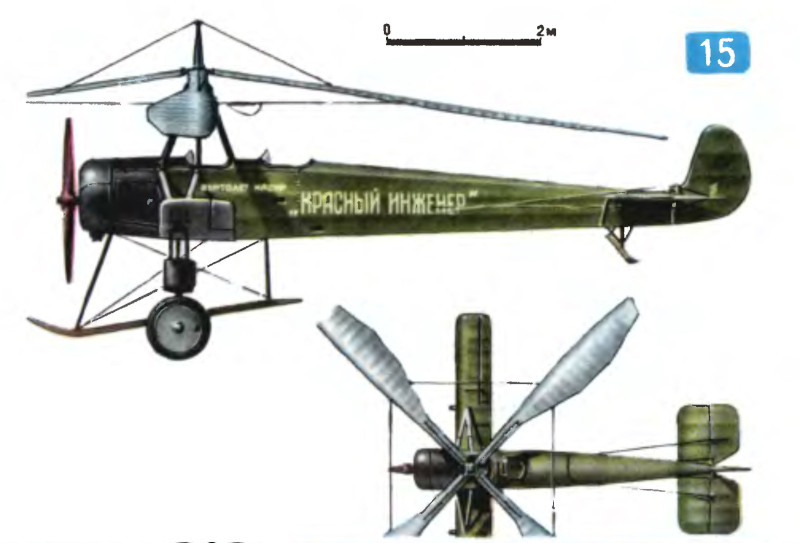 |
| 15. Autogyro KASKR-1 (USSR, 1929). Engine – “Rhone”, 110 hp. Rotor diameter – 12 m. Takeoff weight – 950 kg. Empty weight – 750 kg. Max speed – 110 km/h. Min speed – 35 km/h. The flight data given correspond to the KASKR-2 (1930) equipped with a “Titan” engine, 230 hp. |
Like all inventors who dared to bring their idea to life, Cierva tasted the full measure of mistakes and failures. His craft with coaxial, contra-rotating rotors never lifted off the ground – the drag was too great for the 60-hp engine. Moreover, the autogyro showed a tendency to roll onto its side. The imbalance of forces arose because the lower rotor, working in the slipstream of the upper one, rotated at half the speed. The second machine (1921), fitted with a single three-bladed rotor, was little better: it rose only half a meter. Only the fourth autogyro, and then after fifteen radical modifications, managed a 180-meter horizontal flight.
If one blade moves forward in the direction of flight, the speed of the airstream hitting it is the sum of two components: the aircraft’s own speed and the forward speed of the blade relative to the fuselage. The opposite blade moves backward, and its rotational speed is reduced by the aircraft’s forward speed. Consequently, the lift of the right and left blades differs: greater where the speeds add, smaller where they subtract. Hence the strong lateral moment, tending to tip the autogyro toward the retreating blade.
Cierva eliminated this moment by attaching the blades to the rotor hub not rigidly, as in earlier models, but via a horizontal hinge. Now, no matter how asymmetrical the lift distribution across the rotor disk, the blades did not transmit the moment to the hub – and therefore to the fuselage – but instead oscillated freely on the hinge depending on the lift at each instant of their rotation.
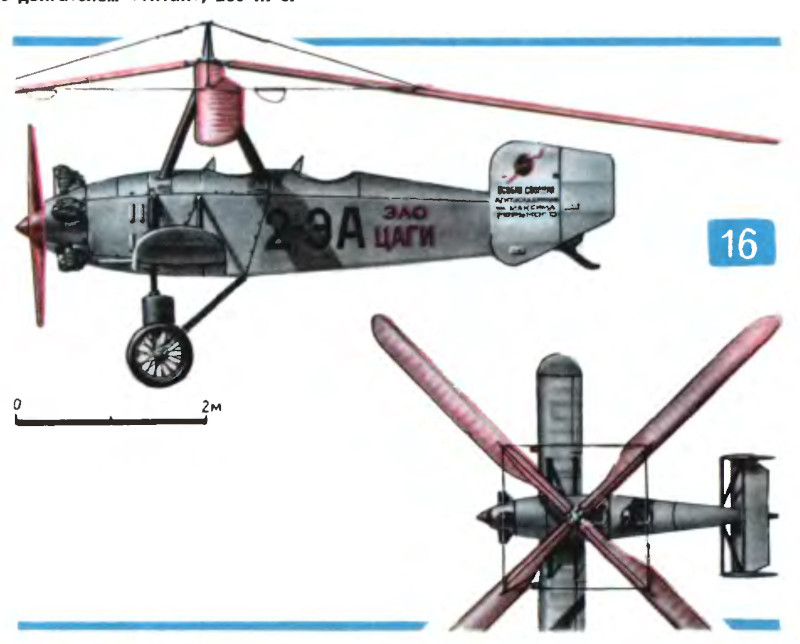 |
| 16. Autogyro TsAGI-2EA (USSR, 1931). Engine – “Titan”, 230 hp. Rotor diameter – 12 m. Takeoff weight – 1032 kg. Empty weight – 765 kg. Max speed – 160 km/h. Min speed – 58 km/h. Service ceiling – 4200 m. Rate of climb at ground level – 4 m/s. |
Alas, the problems did not end with the introduction of horizontal hinges on the autogyro. Having gained stability, the rotor refused to bank right or left when the pilot attempted lateral control. On the C-5 model (1923), Cierva solved this too – he mounted long booms with airplane-type ailerons on the sides of the fuselage.
The improved sixth model attracted wide attention in 1924. The C-6 made two flights lasting 8 minutes, then flew from one airfield to another, covering 12 km. Its speed was respectable – about 100 km/h. Thanks to the inertial rotor, the autogyro demonstrated an almost vertical descent with minimal landing roll.
In 1925, at the invitation of the British government, Cierva demonstrated the autogyro in England. The tour was a success, though marred by an accident during a test flight of the C-6 by a British pilot. At 60 m altitude, one of the four blades suddenly detached. Fortunately, the remaining three continued to rotate, and although another blade came off closer to the ground, the pilot escaped with only bruises.
Once again, the designer turned disaster to advantage. Analyzing the failure, he literally traced it to the root of the blades. It turned out that at the blade roots, during flight, another powerful moment arose in the plane of rotation. In full accordance with mechanics, a blade engaged in two motions – rotation around the circle and flapping on the horizontal hinge – tended to oscillate in the plane of rotation. What it lacked until then was a vertical hinge at the hub. After making countless oscillations during flight, the blade could not withstand the large alternating loads.
Now the autogyro possessed all the elements needed to become a truly flying machine. The C-8, built in 1927–1928, was demonstrated across Europe, including a flight from Paris to London.
The year 1929 marked the first Soviet autogyro, designed with OSOAVIAKhIM funding by engineers N. Kamov and N. Skrzhinsky. Inspired by Cierva’s C-8, the Soviet KASKR differed in many respects from the foreign prototype, as did another of our first-generation machines – the TsAGI-2EA, modeled after the C-19…
Frontispiece: Cierva Autogyro C-2 (Spain, 1921). Airplane-type fuselage with conventional tail controls, elevators, and rudder. Three-bladed rotor, blade pitch could be adjusted on the ground.