


On a late August night in 1930, a cart slowly moved along one of the Moscow region highways, carefully skirting every rut.
This horse-drawn transport was carrying an unusual load: a long structure wrapped in canvas, mounted on inflated wheels with elegant spokes. Only in the early morning did the procession reach its destination, and the cart’s iron rims pressed into the lush grass of Ukhtomsky airfield.
This was how, in the most prosaic way, the most unusual of all flying machines built by domestic specialists at that time was delivered to the test site. The canvas “wrapping” concealed the first Soviet helicopter—or, as such machines were then called, a helicopter—created by a team from the Experimental Aerodynamics Department (EAD) of TsAGI.
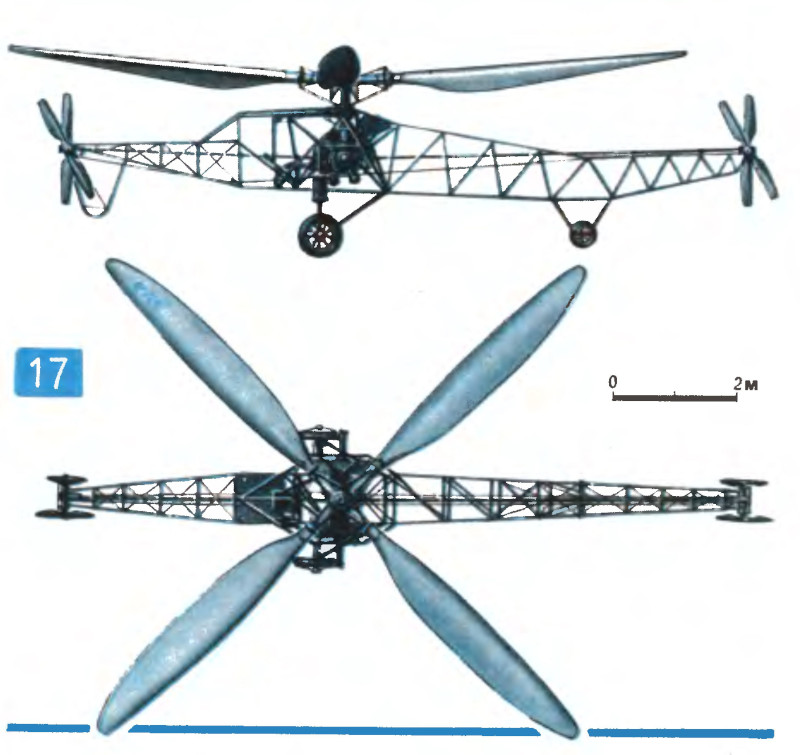 |
| 17. TsAGI 1-EA helicopter (USSR, 1930). Engine — M-2, rotary, air-cooled, 120 hp, 2 units. Diameter of the four-blade main rotor — 11 m, rotation speed — 153 rpm. Flight weight — 1145 kg, max speed — 20–30 km/h, static ceiling — 605 m. |
In those distant years, it was rare for a new flying machine to have such a large amount of theoretical and experimental data behind it. Sometimes a new aircraft, whose designer had the necessary scientific information, relying too much on personal experience, intuition, or simply luck, barely managed to take off and returned to the ground only thanks to the pilot’s skill. And if even a tested airplane design could still present surprises now and then, what could be expected from a helicopter, in which every component or unit—no matter how small—was an unsolved mystery!
“Keep in mind that the problem of creating a helicopter is one of the most difficult in aviation,” said in the spring of 1925 the then-head of the EAD of TsAGI, B. Yuriev. “Before you lies an interesting and captivating field of aviation science and technology, but the path is long and very hard. One must deeply believe in the possibility of solving this problem, be able to inspire this faith in all colleagues, and fight against the skepticism of many, very many…”
The young TsAGI staff soon became fully convinced of how right the ‘patriarch’ of Soviet helicopter design had been: the helicopter builders faced plenty of difficulties and disappointments, yet success came sooner than anyone could have expected. In the best TsAGI traditions, the group did not follow the path of mere inventiveness. Before building the actual metal aircraft, they conducted years of experiments to determine how the main rotor behaved close to the ground, in autorotation mode, and which layout—single- or multi-rotor—would yield the best results.
Out of many schemes, the researchers selected three that at the time seemed most promising: a twin-rotor transverse design, an eight-rotor design, and a single-rotor (“Yuriev”) design with a tail rotor. Helicopters of these three “favorite” layouts were subjected to detailed draft development, carried out to a point where it was possible to reliably estimate the weight of components for an overall weight summary.
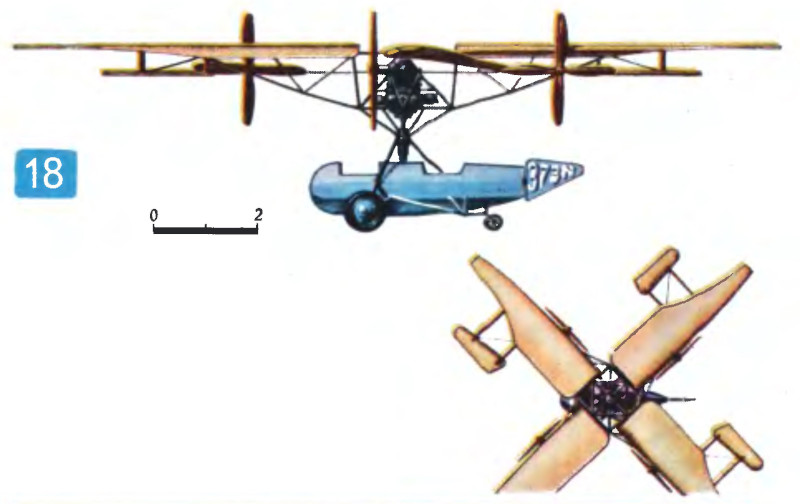 |
| 18. Blikker helicopter (USA, 1932). Built according to the Wellner scheme: the main rotor is driven by small propeller-engine units mounted on wide and relatively short blades. No data exist on successful flight tests of this aircraft. |
But even that was not enough for the designers, who were venturing into completely unexplored territory. Each layout was tested experimentally. The first, with blades equipped with stabilizer-flaps for control, was tested using a so-called rotor device. The second, consisting of eight completely identical propeller-engine units, was tested on two such elements, building a full-scale stand with 2-meter diameter rotors. Finally, the single-rotor design was investigated through extensive experiments with a two-blade main rotor powered by a 120-horsepower aircraft engine. Only after these and many other works did the group, led by World War I military pilot, design engineer, and later MAI professor A.M. Cheremukhin, begin designing the helicopter in late 1928.
In July 1930, having created unique, purely helicopter-specific assemblies—the four-blade main rotor, the central gearbox, freewheel clutches, and other components of a complex, branched transmission—the specialists began full-scale testing of the machine. Its unusual nature was matched by the environment in which the first trials took place: not daring to move the helicopter to the airfield right away (in case major redesigns were needed), the team that built the helicopter set up on the second floor of an unfinished TsAGI building. There, in the presence of a firefighter with a full set of fire-extinguishing equipment, Cheremukhin—who also served as the pilot of the TsAGI 1-EA experimental aircraft—conducted its first, purely ground-based tests. After those trials came the nighttime march to Ukhtomsky airfield, allocated for flight testing of the new machine by order of Deputy People’s Commissar for Military and Naval Affairs M.N. Tukhachevsky.
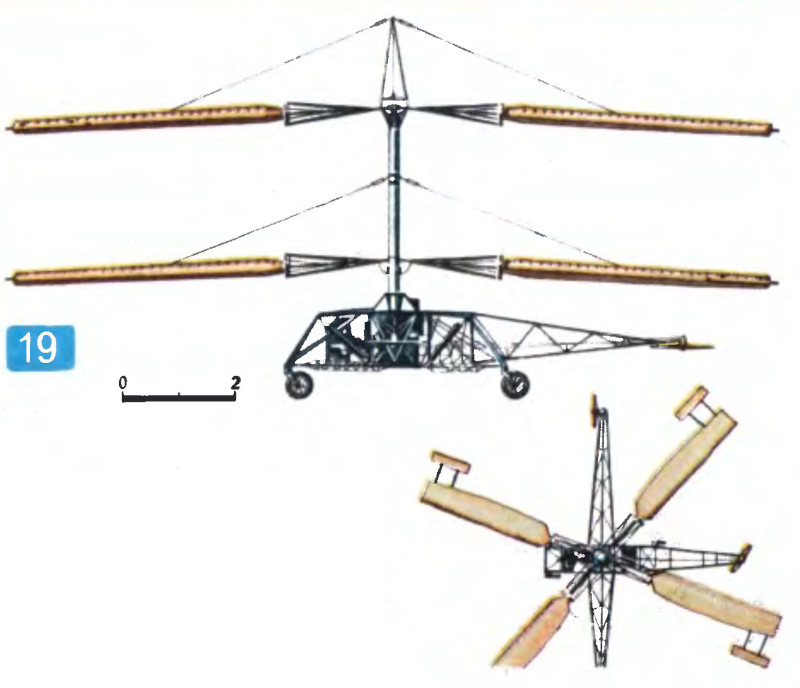 |
| 19. Ascanio helicopter (Italy, 1930). Engine — Fiat A-505, 95–100 hp. Diameter of coaxial rotors — 13–15 m. Rotation speed of upper and lower rotors — 75 rpm. Total weight — about 800 kg. Maximum altitude — 18 m. Achieved flight duration — 8 min 45 s. |
The history of the first Soviet helicopter, which surpassed all foreign designs of its time, contains many dramatic and heroic pages. But it is not by chance that I dwell so extensively on the machine’s background. The thorough preparatory work bore fruit, and the aircraft—destined to become a milestone in world helicopter development—quickly demonstrated flight characteristics never before seen.
Already in September 1930, Cheremukhin was freely maneuvering the helicopter at 10–15 meters above the ground, and by late autumn he was flying at 40–50 meters—two to two and a half times higher than the official world record set the same year by the Italian Ascanio helicopter. Two years later, the TsAGI 1-EA was climbing to nearly 300 meters, and on a quiet August night in 1932, it reached an incredible altitude of 605 meters! This record exceeded the Italian one by a factor of 34.
The TsAGI 1-EA, like other helicopters built by specialists of this world-famous research center, was never destined to become a prototype for serial production aircraft. Yet without them, it is impossible to imagine the formation of the Soviet school of helicopter engineering. In the early work on this pioneer were trained outstanding scientists and designers such as A.M. Isakson, K.A. Bunkin, A.F. Maurin, G.I. Solntsev, and I.P. Bratukhin—later MAI professor, State Prize laureate, and chief designer of the “Omega” helicopters—and many others whose names are forever inscribed in the history of our aircraft industry.
The front illustration shows the TsAGI 1-EA helicopter (USSR, 1930).