

"Just as a propeller cuts through the air, a ship's screw through the water, and a cutting tool through metal or wood, so the plowshare cuts through the soil. But while in working metal or wood the shavings are waste, in working the soil the clods or lumps of one size or another constitute the entire purpose of the work."
In this statement by the outstanding Soviet scientist, Academician Vasily Prokhorovich Goryachkin, the essence of the work of one of the most ancient tools is clearly shown.
The successes of the Soviet Republic in establishing agriculture become particularly convincing when one considers the legacy it inherited from old Russia. According to the 1910 census, peasant farms had 7.8 million sokhas and wooden plows, and 6.4 million wooden and steel plows. During the years of the Imperialist and Civil Wars, the stock of these primitive tillage implements decreased markedly. In 1918, in Moscow province there was one plow for every two peasant farms, and in Kiev province, one for every eight farms. Yet tillage is the most energy-intensive operation in agriculture. Plowing accounts for 60% of all energy needed to cultivate one hectare of grain crops, including transporting the harvest.
That is why immediately after the Civil War, the plant named after the October Revolution in Odessa resumed production of plows, and in October 1928, its workers celebrated a remarkable victory – they reported on the millionth plow manufactured under Soviet power. Initially, the Odessa plant and other factories in the country supplied the countryside mainly with horse-drawn single-furrow plows. But then the "Fordson-Putilovets" and STZ-KhTZ-15/30 tractors began to reach the villages, and the output of these factories increasingly included tractor-drawn implements. However, these implements proved unsuitable for the powerful tracked vehicles from the Chelyabinsk Tractor Plant.
To efficiently load the S-60 tractor, wide-cut eight- and ten-furrow plows were required. At first, it seemed that the issue could be resolved purely arithmetically – lengthen the frame and add the corresponding number of bodies. However, the country's first eight-furrow plow, built in 1930 under the direction of Professor Sladkov at the Bryansk "Profintern" plant, and a similar plow by the designers of the Omsk "Sibselmash" plant, developed in 1933, proved unsuccessful. Moreover, failure befell the Omsk and Chelyabinsk designers – from the Kolyushchenko plant – again the following year. The situation was truly dramatic. The Chelyabinsk Tractor Plant was reaching its design capacity, replenishing the fleet of grain state farms with tens of thousands of steel giants each year, yet they plowed with old plows in double and triple hitches.
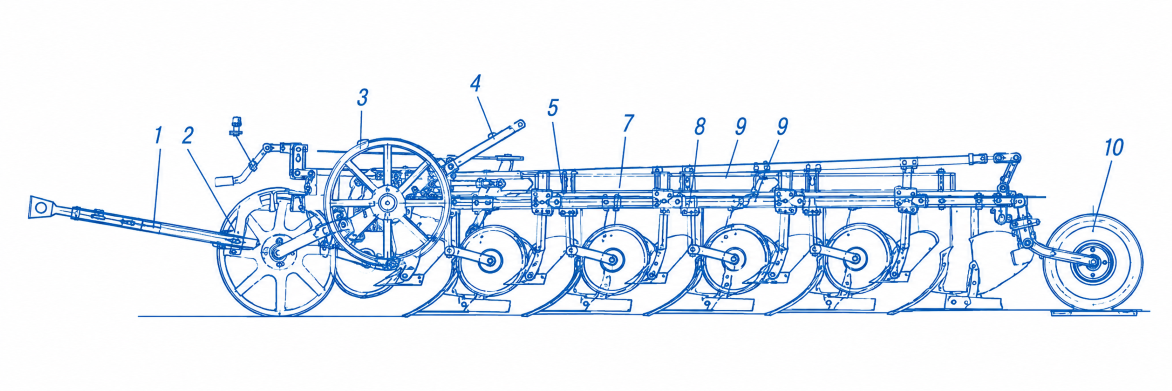 |
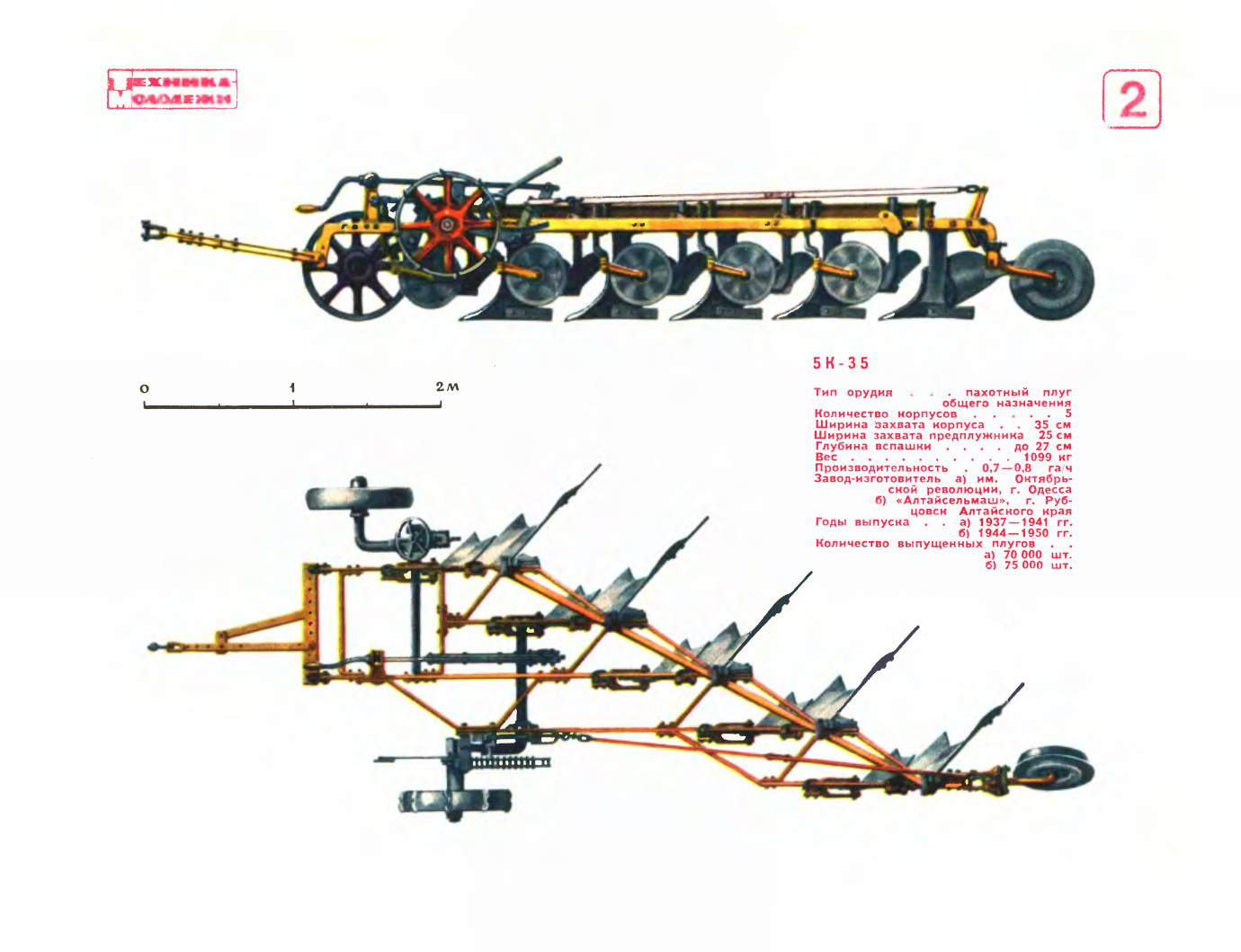
| FIVE-FURROW PLOW 5K-35: 1 — hitch, 2 — furrow wheel, 3 — adjusting screw handle for the land wheel, 4 — land wheel, 5 — automatic control lever, 6 — flat frame, 7 — disk coulter, 8 — jointer, 9 — rear wheel linkage rod, 10 — plow body, 11 — rear wheel. |
By a special resolution of March 7, 1935, the Council of People's Commissars instructed the People's Commissariat of Agriculture and its subordinate All-Union Institute of Mechanization to create a wide-cut plow as soon as possible, so that it could be sent for testing in the autumn. VIM scientists, together with designers from the October Revolution plant, developed eight- and ten-furrow plows on a rigid frame and manufactured them in Odessa.
Tests in Armavir (simultaneously with models sent from Chelyabinsk and Omsk) showed that due to its considerable length (10 m), the ten-furrow plow did not follow the terrain well – it failed to provide the required plowing depth in saucer-shaped depressions and buried itself in hummocks, overloading the tractor. The eight-furrow plow, with a length of 8.6 m, had an advantage in this respect, so for 1936 the factories in Omsk and Odessa received an order to manufacture a batch of 5,000 such plows.
By the end of the tests, events had taken a new turn. By government decree, the Stalingrad and Kharkov Tractor Plants were being converted to produce the medium-power tracked tractor STZ-NATI. According to preliminary calculations, loading it for plowing required a five-furrow plow. The designers then decided to kill two birds with one stone – to develop for the STZ-NATI a plow which, in double hitch, would also satisfy the S-60. Design work proceeded in parallel at the plants and at VIM during the winter of 1935/36.
The designers sought to create a plow that would best meet the agronomic requirements of the time. Therefore, they installed jointers in front of the plow bodies, which cast the upper pulverized layer of soil to the bottom of the furrow, while the main body turned the lower structural layer onto the surface of the plowed field. Moreover, the jointers better incorporated plant residues and weeds into the soil. Reliable plow operation required choosing the optimal distance between the body and the jointer. With small distances, this space could become clogged with stubble, while with large distances, the plow's length increased. The designers chose a maximum plowing depth of 27 cm so that the plow would be suitable for plowing under all major field crops.
From September to November 1936, an interdepartmental commission tested five-furrow plows and hitches presented by designers from Odessa, Chelyabinsk, Rostov, and also VIM at the VIM experimental station in Armavir. The plows that best met the agronomic requirements were the VIM plow V-535U and the Odessa plow 5K-35, whose main parameters and working surface shape were taken from the V-430 plow developed at VISHOM. Two of their bodies were removable, which made it possible, through simple operations, to obtain plows or hitches ranging from three to ten bodies with a cutting width of 105 to 350 cm.
Based on the 5K-35, designers at the Odessa plant developed for the heavy soils of Armenia and Uzbekistan the three-furrow reinforced plow 5K-35U, and for plowing under industrial crops to a depth of 40–45 cm – the 5K-35UP with subsoilers. At the same time as the Odessa plant, five-furrow plows were also produced by Rostselmash – the TPU-5 No. 2, and Sibselmash – the TSB-35, which differed insignificantly from each other. By the end of the second five-year plan, five-furrow plows had assumed a leading position.
Based on these three plows, even before the war, a plow unified across all components, the P-5-35, was developed. Its production began in 1940, but it entered history as the main plow in the post-war restoration of the country's agriculture.
LEONID YEVSEEV, engineer