


The major political, economic, and military successes achieved by Russia as a result of the grand transformations of the first quarter of the 18th century brought it into the ranks of the world’s leading powers. Tempered in the battles of the long Northern War, its army grew stronger. At the same time, Peter I was among the first to understand the close interconnection between military affairs, the economy, and science. At his insistence, many prominent scholars belonging to the St. Petersburg Academy of Sciences, founded in 1725, were involved in solving purely military problems.
Few people know that M. V. Lomonosov developed a new composition of artillery gunpowder that included potassium nitrate, charcoal, and sulfur. Incidentally, it has undergone no significant changes up to the present day.
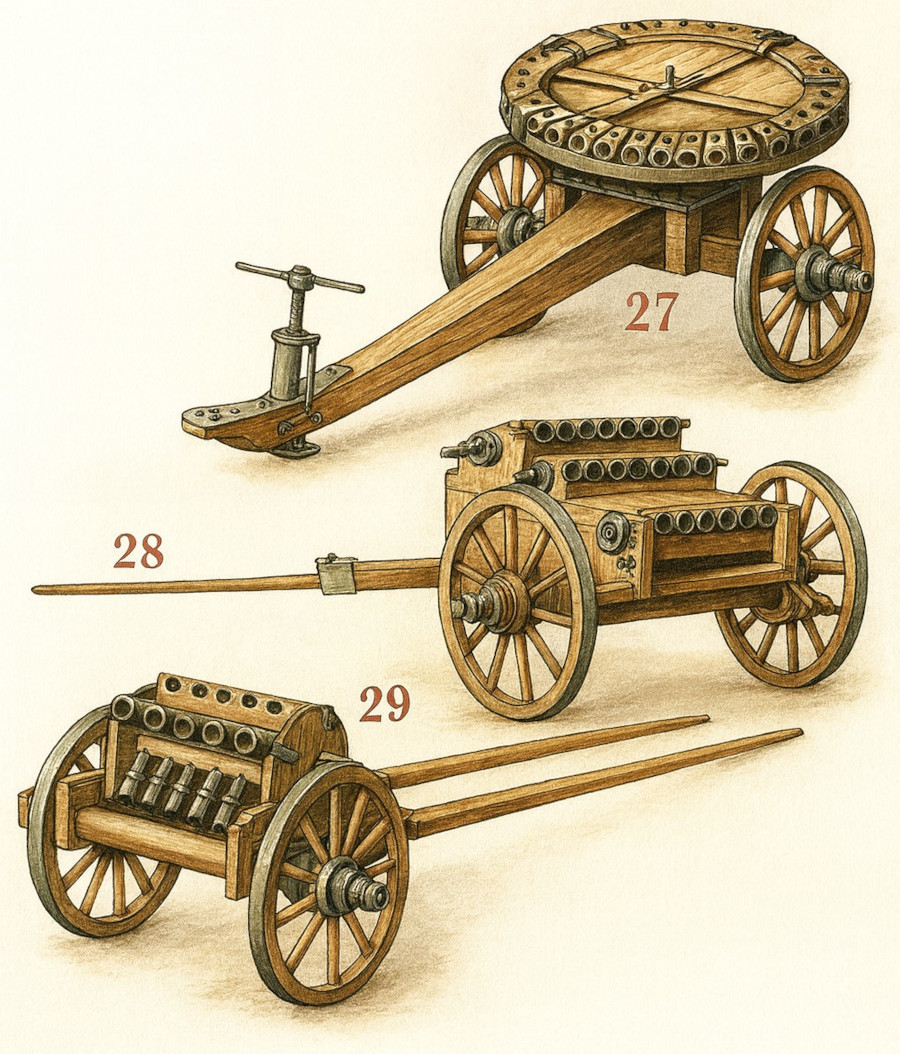 |
| 27. Forty-four-barrel rapid-fire battery by A. K. Nartov. 28. Three-tier installation comprising 24 mortars. 29. Twenty-four-barrel installation “Organ”. |
Academician I. Lejtman holds priority in the development of the theory of rifled weapons. In 1728, during the period of universal dominance of smoothbore artillery, he published in the “Commentaries” of the St. Petersburg Academy of Sciences a work entitled “On how, in a barrel of a given length, to correctly cut spiral grooves of a definite twist.” Advocating the introduction of rifled artillery into the army, Lejtman in his work “On certain new and remarkable experiments and considerations concerning artillery” (1729) proved that it is more expedient to fire elongated projectiles from rifled guns rather than traditional round shot, since the former “not only strike the target better, but also retain a motion more suitable to rectilinear travel.” In this connection, it is worth recalling that the Englishman Robins, to whom foreign historians long attributed priority in the theoretical explanation of the influence of rifling on shooting accuracy, made his discoveries 14 years after Lejtman. And in 1730 a new study by the Russian scientist appeared — “Conclusions and experiments on certain rare and curious cases of firing from rifled weapons,” in which the scholar proposed polygonal barrels of elliptical cross-section — a hundred years before the English!
A member of the Russian Academy of Sciences, Daniel Bernoulli made a significant contribution to the creation and development of the theory of internal ballistics, while the eminent mathematician Leonhard Euler calculated firing tables that Russian artillerymen successfully used for an entire century.
The development of military science had a direct impact on the work of gunsmiths. The most outstanding of them in those years was probably the remarkable mechanic A. Nartov. A “fledgling of Peter’s nest,” after graduating from the navigation school he became the tsar’s personal turner, and later took the post of adviser to the Chancellery of the Main Artillery and Fortifications. Once engaging in the problem of increasing the rate of fire of batteries, Nartov in 1741 invented a three-pound artillery system consisting of 44 small mortars mounted in several groups on a wooden horizontal wheel. In battle, while some groups of mortars delivered salvo, dispersing fire, others were being loaded. In the tail section of Nartov’s battery there was a metal screw used to give the gun the required elevation angle. Later, on the same principle, the inventor created a 24-barrel installation “Organ”.
 |
|
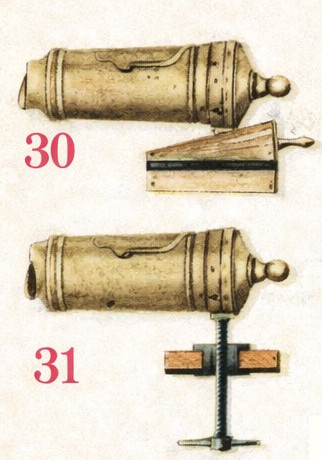
30. Elevating wedge placed under the breech of the gun. |
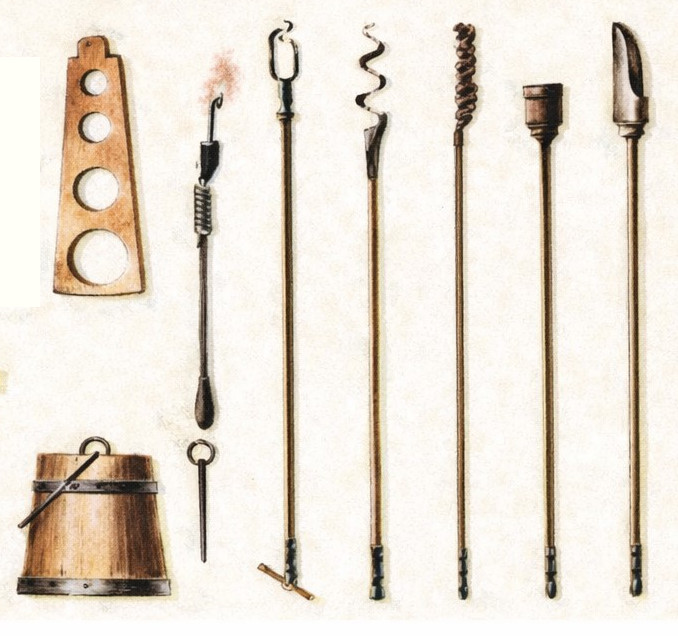 |
| Equipment of 18th-century artillerymen (from right to left): shovel — a scoop for ramming powder into the barrel, rammer, cleaning swab wrapped in sheepskin used for cleaning the barrel, ordinary swab, wad extractor, linstock, pricker, board used to determine the caliber of shot, and a bucket in which the swab was moistened. |
Nartov addressed the problem of using over-caliber projectiles no less originally. In 1744, during experiments, artillerymen fired six-pound projectiles from three-pound guns, and two-pood bombs from twelve-pounders. On the basis of such experiments, specialists concluded that “of such a newly introduced fiery invention nothing has been heard either in Russia or in other states.”
Not limiting himself to the development of new guns, Nartov created a device for aiming cannons at a target. It was a graduated scale attached to the vertical aiming system. This innovation freed gunners from the need to use a cumbersome quadrant under combat conditions.
And that was not all — the talented inventor proposed new methods of casting barrels and turning trunnions, grinding projectiles, and much more. Some developments of the outstanding Russian gunsmith have not lost their significance to this day.
…It would be naive to assume that the development of artillery proceeded without vexing mistakes and false paths. Thus, in 1734 hastily designed, seemingly promising guns were adopted, which in practice proved to be unwieldy and possessed an extremely low rate of fire. Suffice it to say that crews spent up to two minutes to fire a single shot. For this reason, it was necessary to abandon rapid cartridge loading and to “arm” the cannoneers with a long shovel — a device by which the charge was placed into the bore. Attempts were made to give the guns the required elevation angle by means of an oak wedge driven under the barrel, which, of course, did not ensure uniformity and accuracy in aiming the batteries.
 |
|
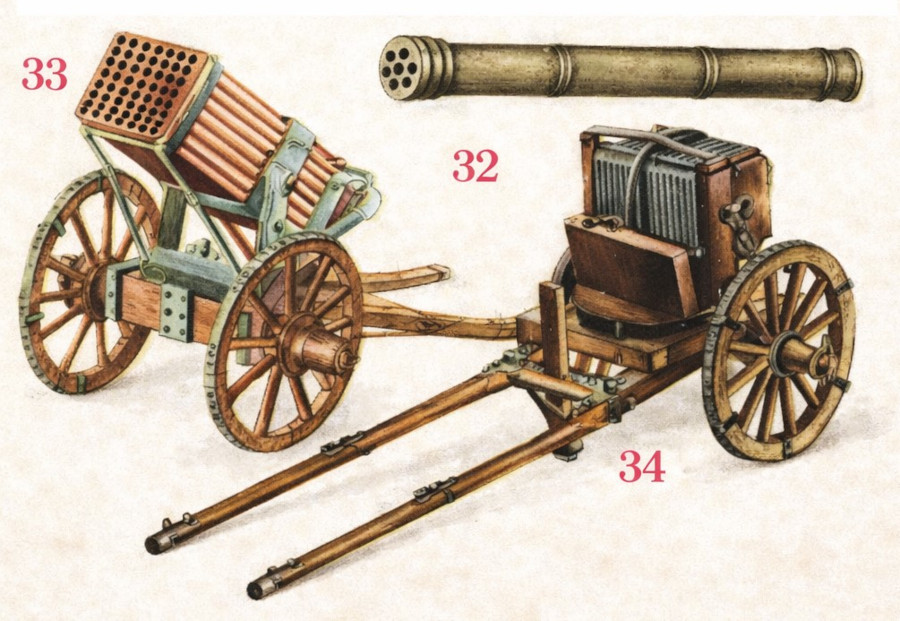
Some examples of foreign multi-barrel guns: |
However, already in 1744 Colonel M. A. Tolstoy, setting himself the task of increasing the rate of fire and accuracy of artillery fire, proposed replacing the ineffective oak wedges (which shifted after each shot) with an elevating mechanism consisting of a vertical screw and a fixed nut.
Four years later, Lieutenant Colonel I. Demidov insisted on a return to the cartridge method of loading guns. He also developed improved rapid-ignition tubes and bristle swabs for artillerymen, which made it possible to clean the bores more quickly and effectively after firing.
The new artillery systems, developed and refined with account taken of the combat experience of the Northern War, successfully passed their trial on the battlefields of the Seven Years’ War (1756–1763). They also served as prototypes for new guns that were used in battles against Napoleonic troops at the beginning of the 19th century. But that is a subject for later…
On the title image: multi-barrel guns on the battlefield (after a German drawing of the 16th century).