


At the beginning of the 18th century, Peter I carried out a radical reorganization of the country’s armed forces. Significant changes also affected their main branch — the artillery.
In 1701–1706, instead of the Cannon Department, which no longer met the demands of the time, Peter introduced a new organizational structure of the artillery, dividing it into light regimental, field, siege, and fortress artillery. Abandoning the old classification of artillery systems into archaic arquebuses, houfnices, culverins, and scatter-guns, “bombardier of the Preobrazhensky Regiment Peter Alexeyev” officially established only three types of guns — cannons, intended for aimed fire with round shot and grapeshot, and mortars for high-trajectory fire. Howitzers, created after the appearance of explosive shells, had a stronger barrel compared to cannons.
 |
|
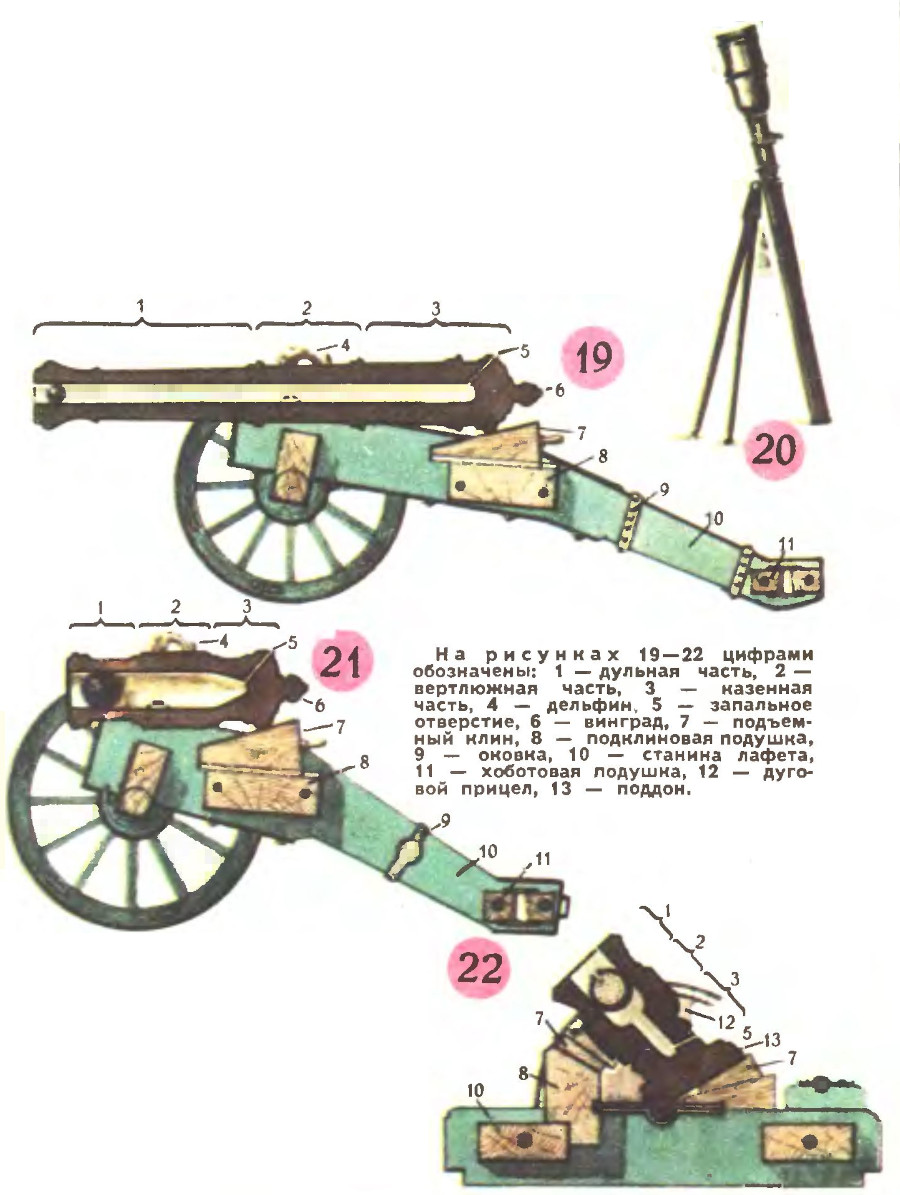
19. Eighteen-pound siege cannon, caliber 139.7 mm. Barrel length — 20 calibers, 20. Six-pound mortar on a tripod. 21. One-pood howitzer, caliber 215.9 mm. Barrel length — 8 calibers, barrel weight — 80 poods, 22. Five-pood siege mortar with arc sight. Caliber — 349.2 mm, barrel length — 5 calibers, |
Structurally, cannons and howitzers were quite similar. Their cylindrical, smoothbore barrels were divided into the muzzle, middle (trunnion) and breech sections, ending with a cascabel. The breech section contained a vent hole, through which gunners ignited the powder charge using a heated rod. Only the howitzer’s chamber was usually conical or cylindrical, and its barrel was much shorter than that of the cannon.
On the trunnion part of cannons and howitzers were the trunnions, by which the barrel was attached to the carriage, and special dolphin-shaped lifting handles that helped the crew transport the gun and mount it onto the carriage. Cannon and howitzer carriages differed only in size and weight, generally representing a reinforced wooden two-wheeled frame made from a single timber and joined with iron bolts and straps at the trail (rear part of the carriage) and wooden pads in the middle.
Vertical aiming of the guns was done using a quadrant and a wooden wedge placed under the breech part of the barrel. Horizontal aiming was performed by lifting the trail and shifting it from side to side.
Unlike cannons and howitzers, the mortar barrel was shorter and ended with a conical or cylindrical chamber. These guns had a fixed elevation angle of 45° and a wheel-less mounting. Mortars were aimed using quadrants.
In 1707 Peter established a unified scale for determining caliber based on the weight of the projectile in artillery pounds, the standard of which was considered to be a cast-iron ball two inches in diameter, and in commercial poods. Incidentally, this system remained in Russia until 1877.
Instead of the previous 25 types of artillery pieces, Peter left only half in service.
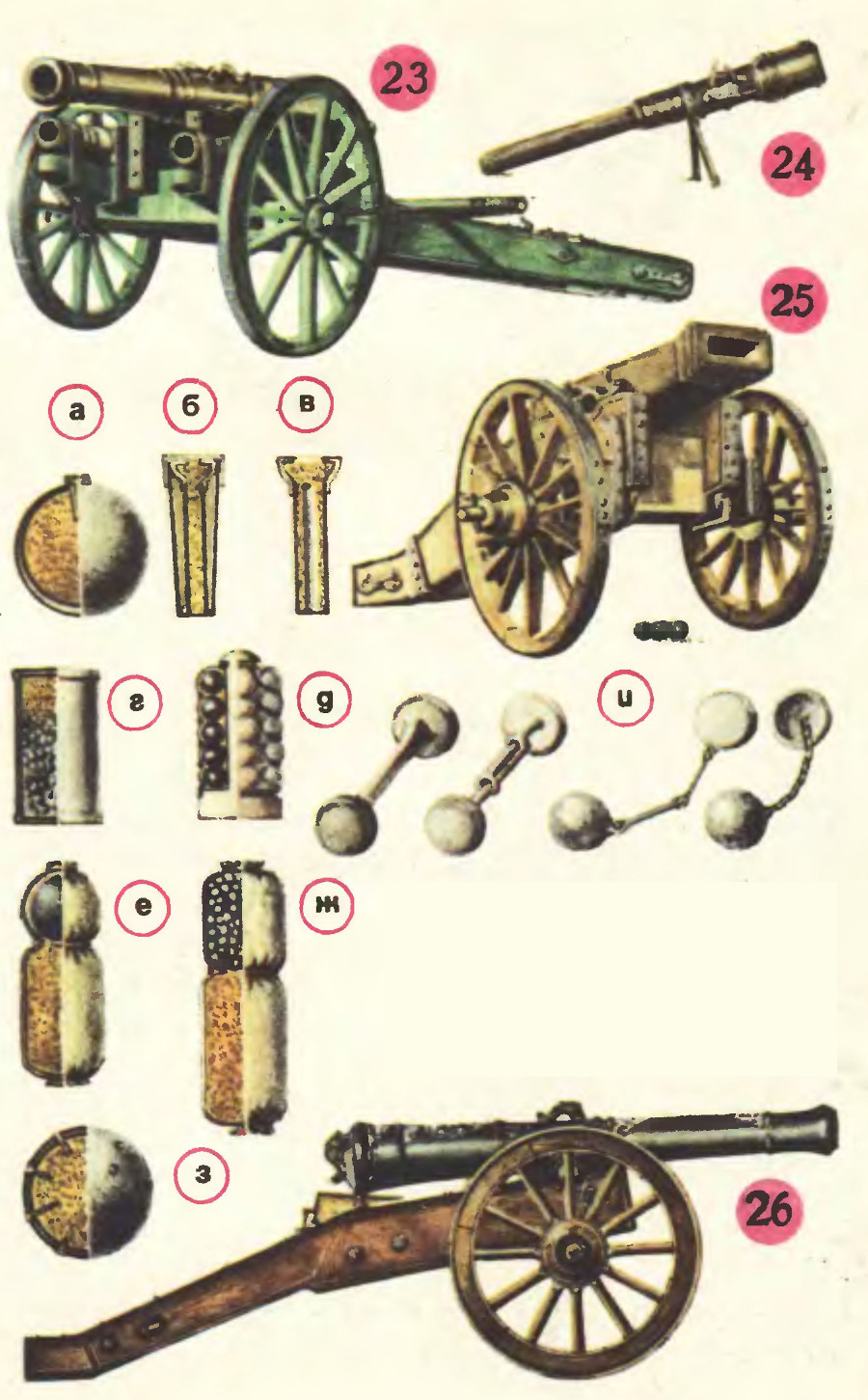
The main types of ammunition in Peter’s era remained cannonballs, grenades, bombs, grapeshot, and special projectiles. For example, against Swedish frigates, chain shot and bar shot were used, tearing sails and rigging and depriving enemy ships of maneuverability. To increase rate of fire in regimental and field artillery, cartridge bags began to be used — cylindrical paper bags pre-filled with a powder charge. Such ready-made charges, later placed in dense cloth, were convenient for transport and storage. The complete rearmament of the Russian army with the new standardized artillery systems was completed by mid-1709. And already during the storming of the fortresses of Noteburg, Nyenschantz, and Narva, the reorganized artillery proved its effectiveness. Reporting the capture of Oreshek (Noteburg), Peter wrote that “this nut was very hard indeed, yet, thank God, successfully cracked… Our artillery performed its task most wonderfully.” And on June 27, 1709, at the Battle of Poltava, Russian bombardiers defeated the best regiments of “Charles XII of Sweden.”
 |
|
23. Three-pound cannon designed by V. D. Korchmin with two 24. Handheld two-pound grenade launcher. Weight — 10 pounds, grenade weight — 2 pounds. 25. Experimental model of a three-pound cannon with a rectangular bore 26. Three-pound ceremonial cannon made in memory of the Battle of Poltava. In illustrations 19–22 the numbers indicate: 1 — muzzle section, 2 — trunnion section, 3 — breech section, |
Of the 1471 projectiles fired by Russian artillerymen in the Battle of Poltava, 572 were grapeshot — this indicates that the cannons were positioned at the decisive sectors of the battle and fired point-blank at enemy infantry. “The decider of victory,” Peter I called the artillery that day.
According to the Treaty of Nystad of 1721, Russia regained its ancestral lands on the shores of the Gulf of Finland. The route to the Baltic Sea was open again!
During the Great Northern War, and even after its end, Peter continued to pay attention to the development of artillery science. By his order, the “Description of Artillery with Drawings” was compiled, which covered “the rules for calculating scales, the dimensions of guns and mortars, the construction of field batteries,” and included firing tables. In 1719, the “Artillery Practice of Major Likharev” appeared, dedicated to high-trajectory firing of bombs and grenades.
New artillery systems were also created during these years. In 1707 the artillery expert V. D. Korchmin, supported by General Feldzeugmeister Jacob Bruce, conducted a series of experiments to determine the best shape of the howitzer chamber, which was expected to significantly increase the firing range of half-pood howitzers. The same Korchmin developed a three-pound cannon with two mortars mounted on its barrel. This innovation sharply increased the density of artillery fire on the battlefield.
The new half-pood howitzer with a conical chamber and a barrel length of 10 calibers had a greater firing range than its predecessor of the same caliber. It was this gun that became the prototype of the famous “unicorn” howitzers that entered service with the Russian army in the mid-18th century.
Front illustration: Russian artillerymen on the battlefield near Poltava.