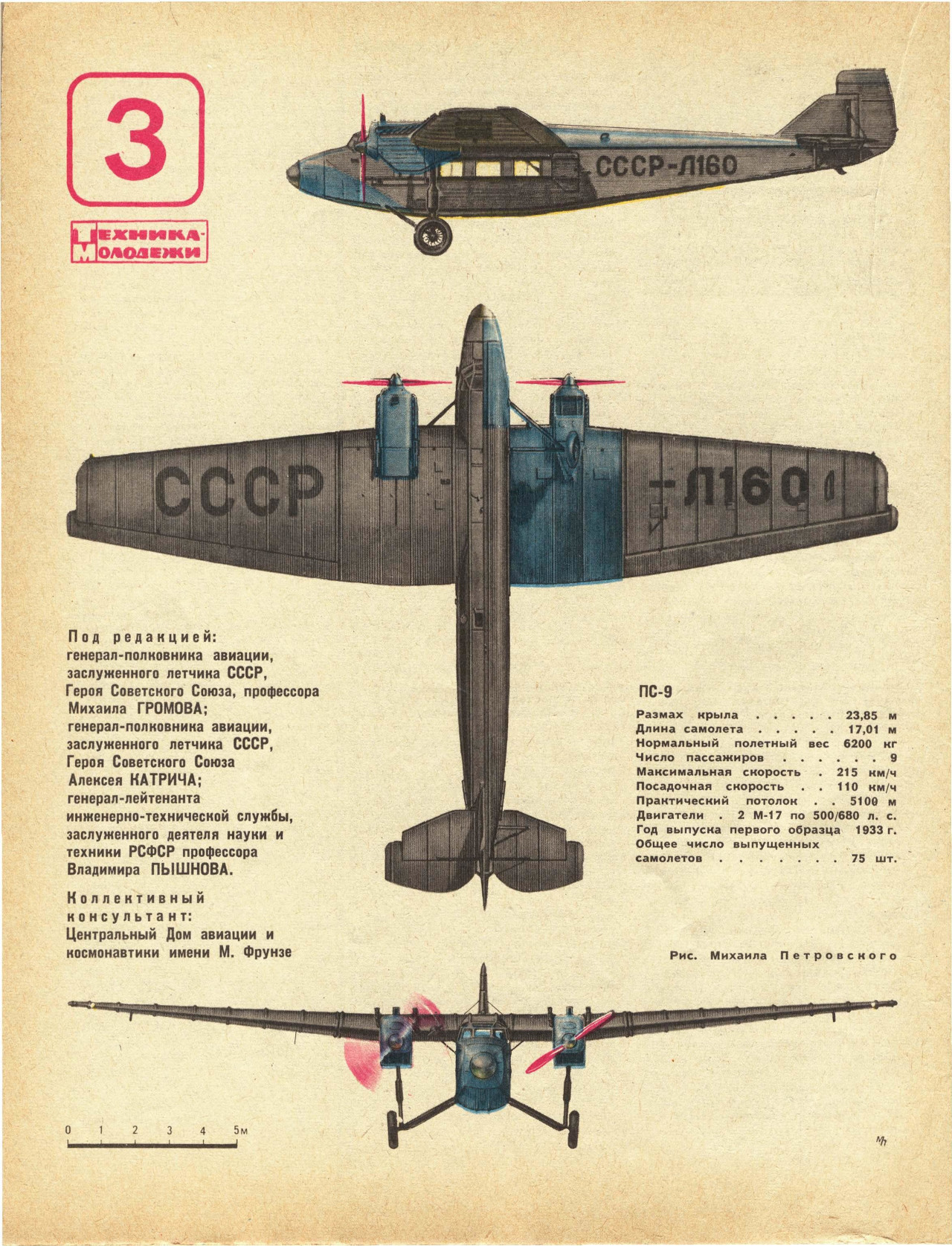


“...We were flying over a forested area and were supposed to reach the right bank of the Dnieper. I began to listen to a strange sound mixed with the noise of the engines.
Moreover, the speed began to drop. I pushed the engine control levers forward to increase power, but the speed kept decreasing. The strange sound grew louder. And the forest seemed endless... Speed 118, almost the limit... I decided to cross the Dnieper to the left, lower bank. Speed—115! Ahead, on the left bank, a strip of land finally appeared; along it ran a path, and beyond it were telegraph poles, which we could no longer clear. I landed on the strip from the Dnieper side. Fortunately, everything ended safely. We all got out and saw: the rain had torn along the edge the fabric covering the propellers, since their leading edges were not reinforced. The fabric kept peeling off more and more, forming something like inflated pockets. The aerodynamics of the propellers were disrupted, which reduced thrust and produced the additional noise...”
This is how test pilot M. Gromov described one of the episodes that occurred during the testing of the first Soviet multi-engine passenger aircraft, the ANT-9, in 1929. The leadership of the Civil Air Fleet had come to the decision to create such an aircraft back in 1927. In December of that year, it issued an assignment to the Department of Aviation, Hydroaviation, and Experimental Construction at TsAGI to build a passenger aircraft for carrying 10 people. This department was headed by Andrei Nikolaevich Tupolev.
Since 1923, when at the plant of Gosprotsvetmet in the village of Kolchugino in the Vladimir region the production of sheets and profiles from a new alloy—kolchugaluminum—had been established, this design team began to specialize in all-metal aircraft. After the ANT-1, a mixed-construction aircraft with some parts made of kolchugaluminum, came the first Soviet all-metal aircraft, the ANT-2. Although it did not go into mass production, it provided invaluable experience for designing subsequent Tupolev aircraft. These included the ANT-3 (R-3) reconnaissance aircraft—a single-strut sesquiplane of all-metal construction—and the heavy bomber ANT-4 (TB-1), an all-metal monoplane with a cantilever wing.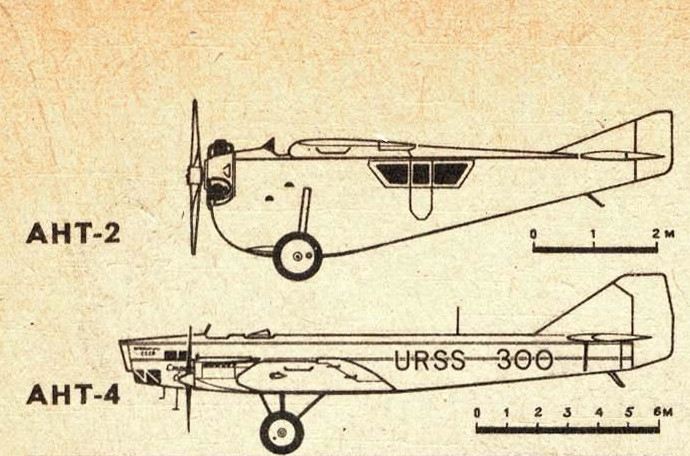 This aircraft is rightly considered an important milestone both in Tupolev’s work and in the development of domestic aircraft construction as a whole. The creation of a cantilever monoplane became possible only after the country mastered the production of light and strong duralumin, which made it possible to switch to a thick-profile wing without external struts or bracing wires. Such a wing offered two key advantages. First, increased lift at high angles of attack, which is necessary for good takeoff and landing characteristics. Second, reduced structural weight. Indeed, due to the greater thickness of the wing, taller spars could be used to carry the main working load—bending. And the greater the allowable spar height, the smaller their cross-section could be, and consequently, their weight. A thick wing made of relatively weak wood cannot be made light enough, which is why in early aviation thin-profile wooden wings with struts and bracing were used. All-metal wings, on the other hand, could be both strong and relatively lightweight.
Following the ANT-3 and ANT-4, created in 1925–1926, work began on the ANT-7—an improved version of the ANT-4. Designed for use as a land- and sea-based reconnaissance aircraft, a medium bomber, and a long-range fighter, this aircraft, designated R-6, proved very successful and helped the Tupolev team quickly fulfill the assignment of the Civil Air Fleet.
On April 9, 1928, after Tupolev’s report, the leadership of the Civil Air Fleet, the Air Force, and TsAGI approved the project, and A. Arkhangelsky was appointed the lead designer for the ANT-9. In October 1928, the aircraft mock-up was approved, and already on May 1, 1929, thousands of Muscovites were able to admire the first prototype: the ANT-9, later named “Wings of the Soviets,” was displayed for public viewing on Red Square. After the May Day celebrations, flight tests began and were successfully completed by June 1929. From June 6–12, M. Gromov carried out a flight on this aircraft along the route Moscow—Odessa—Sevastopol—Kyiv—Moscow, during which the episode described at the beginning of our narrative occurred. The discovered flaw was easily eliminated by reinforcing the leading edges of the propeller blades with copper sheathing, and already on July 10, Gromov, together with eight passengers, set off on a major European flight: Moscow—Travemünde—Berlin—Paris—Rome—Marseille—London—Paris—Berlin—Warsaw—Moscow. The distance of 9,037 km was covered in 53 flight hours at an average speed of 177 km/h.
Meanwhile, preparations for serial production of the ANT-9 had been underway since May 1929. The first prototype was equipped with three French air-cooled Gnome-Rhône Titan engines of 230 hp each. For production aircraft, it was decided to use domestic M-26 engines rated at 300 hp. However, these engines in their production form proved unsatisfactory, and instead, imported American air-cooled engines of 300 hp were installed on the first small batch of ANT-9 aircraft.
However, putting an aircraft with imported engines into large-scale production was clearly impractical, and at that time there was no well-developed domestic engine of approximately 300 hp. That is why engineer-operator S. Komarov proposed converting the three-engine ANT-9 into a twin-engine version powered by two liquid-cooled M-17 engines of 680 hp each. After the modification, the aircraft received the designation PS-9—Passenger Aircraft No. 9. The conversion was carried out in 1932–1933, and from 1933 the first Soviet serial twin-engine all-metal aircraft entered service on the country’s air routes.
For a full 10 years, the PS-9 operated on airline routes mainly in Central Asia and the Transcaucasus. When the Great Patriotic War broke out, these reliable and well-tested aircraft were used in combat air transport operations on various fronts: near Belgorod, Stalingrad, Kursk, and in the North Caucasus. Thanks to its all-metal construction, the PS-9 proved exceptionally durable and resilient. It is documented that two PS-9 aircraft, over 8 years of operation up to 1942, logged 6,170 and 5,205 flight hours respectively and each completed about 2,000 flights.
IGOR KOSTENKO,
Candidate of Technical Sciences