

In 1933, in Kharkov, a novel by writer Vladimir Kuzmich titled “Wings” was published, describing the dramatic events that took place in the Ukrainian Aviasindikat in the mid-1920s.
At that time, local management had the right to independently choose aircraft models for operation on air routes. Using this right, Aviasindikat decided to purchase planes from the German company “René,” allegedly tested through long-term operation. Soviet aircraft designer Luka Kostenko opposed this decision; he had designed a more reliable, lightweight, simple, and inexpensive aircraft. The novel was based on real events in the life of Konstantin Alekseevich Kalinin, who worked in Ukraine...
In 1926, Kalinin’s small design team moved from Kiev to Kharkov and settled in workshops that repaired aircraft of the “Dornier” company, which supplied planes for Ukrvozdukhput. Worried about the appearance of a potential competitor, the company’s owners hastened to take action, and the brother of the company’s owner arrived in Kharkov on an eight-seat Dornier-Merkur passenger plane. The management of Ukrvozdukhput was taken in by the advertising promises of the German firm and decided to place an order with it. At the same time, Ukrainian aircraft builders began to face persecution. These actions, which objectively hindered the creation of domestic passenger aircraft, provoked protests from the working public. Workers sent a letter to the Party Central Committee complaining about the improper actions of Ukrvozdukhput, and as a result, Kalinin’s design team was given the conditions necessary for their work.
By the time the struggle with the “Dornier” firm began, Kalinin was no newcomer to aircraft construction. He had begun working in this field back in 1922, when young Soviet civil aviation was just taking its first steps. On February 9, 1923, the Council of Labor and Defense established the Civil Aviation Council. The organization of air routes was carried out by voluntary societies — Dobrolyot in the RSFSR, Ukrvozdukhput in the Ukrainian SSR, and Zakavia in the Transcaucasian republics. Since there were no domestically produced passenger aircraft at the time, planes were purchased abroad. During the early Five-Year Plans, Soviet airlines mainly used aircraft from the German companies Junkers and Dornier, while on the first international route of Soviet civil aviation, Moscow–Königsberg, aircraft from the Dutch firm Fokker were used. This dependence of Soviet civil aviation on foreign industry motivated Soviet aircraft designers to work tirelessly on creating domestic aircraft. The K-1 — the first airplane designed and built by K. Kalinin at the Remvozdukh plant in Kiev — became such an aircraft.
With this aircraft, Konstantin Alekseevich developed the basic layout of the plane and the structure of its main elements. The design features of this aircraft were consistently used in his subsequent planes.
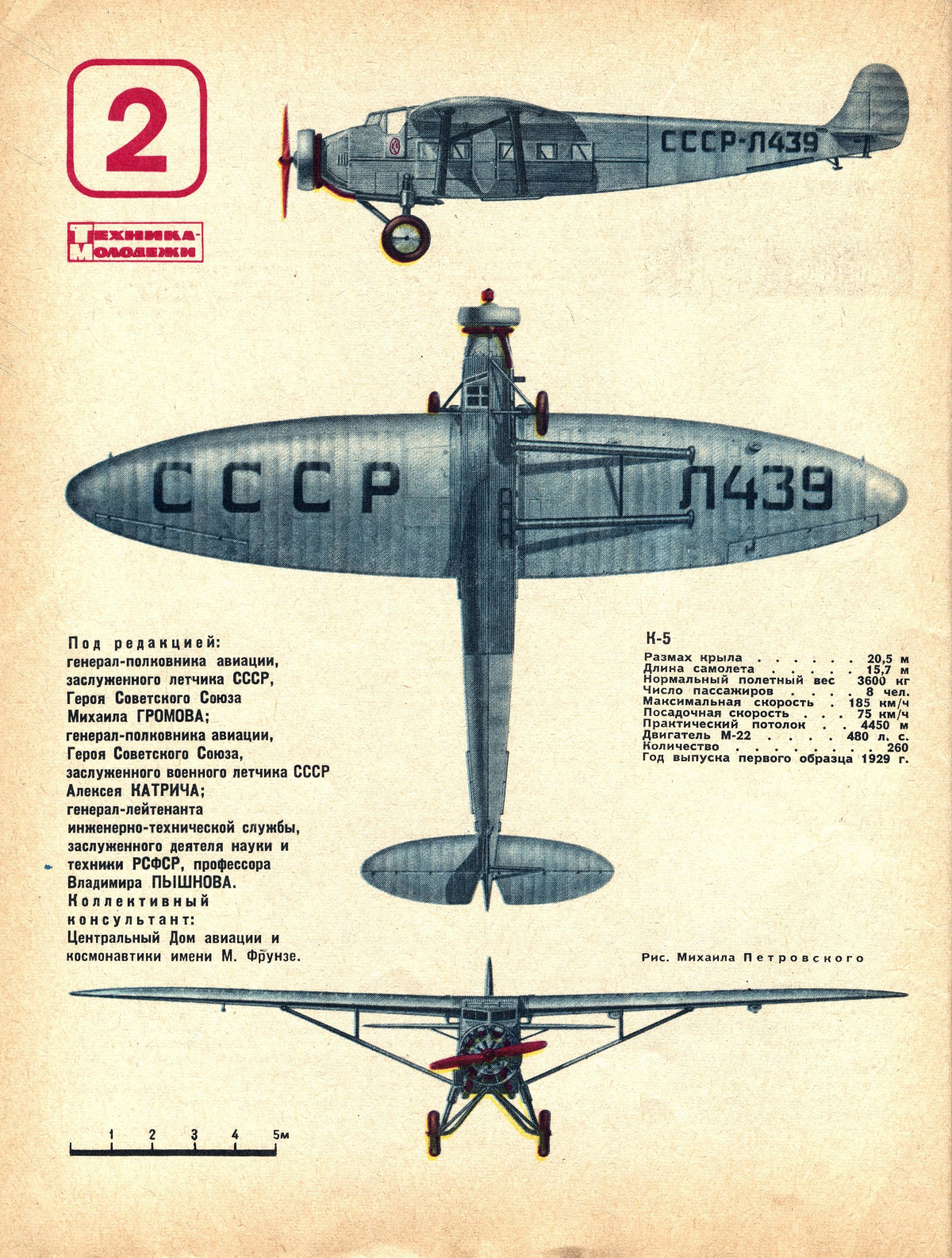
The K-1 was a high-wing monoplane, with the wing attached to the fuselage by a pair of struts. This configuration was very advantageous for a passenger aircraft: its air resistance was lower than that of a comparable biplane, and the high wing position gave passengers a good view — an important factor in those years when air travel was still a novelty. A characteristic feature of the K-1 was its elliptical wing. At that time, the vortex theory of the wing, developed by Professor N. Zhukovsky and later expanded by the German aerodynamicist L. Prandtl, was widely popular in aviation literature. According to this theory, part of the wing’s drag — the so-called induced drag — is minimized when the wing has an elliptical shape. Striving for maximum efficiency in a transport aircraft, Kalinin boldly began to apply the elliptical wing on all his designs, even though this complicated the manufacturing and assembly process. The horizontal tailplane was also elliptical in plan.
The construction of the K-1, like most of Kalinin’s aircraft, was mixed: the fuselage frame and vertical tail, structurally integrated with it, were welded from steel tubes; the wing and horizontal tail were wooden, covered with fabric. The welded fuselage made of steel tubes was built without the usual wire bracing used at that time — the first such design used in the USSR. Kalinin’s aircraft proved to be simple to manufacture, and therefore inexpensive and easy to repair — an important factor for widespread use on air routes. Even on the first K-1, the cockpit for the pilot and mechanic was enclosed by a transparent canopy, and the passenger cabin contained a sofa and seats for three passengers.
In the summer of 1925, the K-1 successfully passed flight tests in Kiev and then completed a flight Kiev–Kharkov–Moscow. State tests were completed in Moscow, and the K-1 was declared suitable for service on air routes. During testing with a 170-hp engine, the aircraft achieved a speed of 161 km/h.
Having gained experience from this aircraft, Kalinin boldly entered into competition with the Dornier designers, developing the K-2 — an improved version of the K-1 fitted with a more powerful 240-hp engine.
In the spring of 1927, design and construction began on Kalinin’s third aircraft — the K-3. It almost completely repeated the layout of its predecessor. The only difference was its purpose: it was the first Soviet specialized medical aircraft, designed to transport two bedridden patients on stretchers.
The next aircraft, the K-4, which made its first flight in the autumn of 1928, was a passenger plane designed to carry four passengers with luggage. In its design, it differed little from the K-3, except that its structure was more carefully refined. Between 1928 and 1929, 22 K-4 aircraft in three versions — passenger, medical, and aerial photography — rolled out onto the airfields.
After the Kharkov–Moscow–Irkutsk–Kharkov flight made by the K-4 aircraft “Chervona Ukraina” in August 1928, these planes entered the Ukrvozdukhput air routes and almost completely replaced the German Dorniers.
The next aircraft developed by Kalinin was the K-5, completed in October 1929.
The prototype K-5 took off for the first time in October 1929. After successful factory and state trials, it went into mass production.
A total of 260 K-5 aircraft with different engines were in operation. This aircraft served not only Ukrainian air routes but also the Moscow–Leningrad, Moscow–Sverdlovsk, and many other lines until 1940. In essence, it was the first Soviet mass-produced passenger aircraft.
Igor KOSTENKO,
Candidate of Technical Sciences