


Roads to other worlds are unlike automobile highways. In space there are its own calculations of routes. The gravity of celestial bodies bends the trajectories of spacecraft, turning them either into closed curves—ellipses—or into open ones—hyperbolas. Along these roads, nearly a hundred Earthlings have already traveled. Half of them are citizens of the USSR, seven are representatives of fraternal socialist countries, and the rest are American astronauts. The total time of human presence in space exceeds five years. (One fifth of this time belongs to twice Hero of the Soviet Union Valery Ryumin.)
Nine Soviet cosmonauts have been in orbit three times (V. Shatalov, A. Yeliseyev, P. Klimuk, V. Bykovsky, N. Rukavishnikov, V. Ryumin, V. Kubasov, V. Gorbatko, O. Makarov), many—twice.
The duration of spaceflight has grown enormously—from Yuri Gagarin’s 108-minute orbit to the more than six-month expedition of L. Popov and V. Ryumin. The mass of spacecraft has also increased by almost an order of magnitude—from the 3.5-ton Vostok satellite-ship to the 32.5-ton modern orbital complex, which carries 2.5 tons of scientific equipment alone.
All these achievements have been made possible thanks to chemical engines with power measured in millions of horsepower. It was they that carried Yuri Gagarin on his historic circumnavigation of the globe. It was they that enabled the Americans to reach the Moon. It was they that allowed humans to reach out with automatic probes to Mars, Venus, Mercury, Jupiter, and Saturn. But for the complete conquest of the solar system, such engines are insufficient.
In the future, new, more convenient and efficient ones will appear—first and foremost based on a nuclear reactor adapted for space purposes. Superheated gases will burst from the nozzles of a nuclear spacecraft at much higher speeds than today; therefore, such a ship will require a smaller fuel supply. This means there will be no need to accelerate excess “ballast,” and as a result the ships’ velocities will also increase significantly.
Already today, scientists are theoretically working through various options for using atomic energy for space travel. For example, a liquid-fuel nuclear reactor will make it possible to heat hydrogen to temperatures above 3000°C. The thrust of such an engine may exceed its own weight by 50 times.
A gas-core nuclear reactor will heat hydrogen to as much as 30,000°C—the exhaust velocity and engine power will increase substantially. And an MHD generator using nuclear fuel will produce thrust exceeding the rocket’s weight by 1,000 times. The exhaust velocity will rise to 100 km/s. It will be able to operate continuously for many months.
The next stage is an isotopic engine, which will provide an alpha-particle exhaust velocity of about 10,000 km/s. The thrust of such an engine may exceed its weight by a million times, and its operating time will be determined solely by the half-life of the selected active isotope and will amount to years.
All these projects are still purely theoretical in nature. However, their introduction into practical cosmonautics will, in all likelihood, occur in the not-too-distant future.
In the longer term, the still vague outlines of a photon rocket come into view, which will be accelerated by the pressure of light. In its annihilation engine, matter and antimatter will combine, completely turning into radiation and releasing energies incomparably greater than any other atomic process. True, it is still too early to speak of the practical use of such engines: we have not yet learned how to obtain antimatter in any appreciable quantities. But it is not impossible that it will be precisely the photon rocket that carries humans to other planetary systems.
However, rockets—both chemical and nuclear—by no means exhaust the arsenal of the future conquerors of space. The confident hands of designers are already sketching in detail far more exotic vehicles. Among them are solar sails, electromagnetic catapults for delivering materials from the Moon, gravilets, a laser ship—something like a space “trolleybus,” to which energy is supplied via a thousand-kilometer “wire” of a laser beam. Finally, the most astonishing project—the “space elevator” proposed by Leningrad engineer Yuri Artsutanov, the design of which readers of “TM” know well thanks to Arthur C. Clarke’s science-fiction novel “The Fountains of Paradise,” published last year.
Be that as it may, not much time will pass, and many thousands of Earthlings will be able to fly annually into near-Earth space (or ascend on space elevators), confirming the prophetic words of K. E. Tsiolkovsky that humanity will not remain forever in its cradle. But an involuntary question arises: why should we leave our beautiful and so hospitable Earth?
After all, we were born on Earth. Our ancestors lived here, creating everything we call human culture, and a “second nature” alongside the one that for millions of years has adorned our blue planet. Where, then, should we fly away from such beauty?
But will it remain forever?—some proponents of a mass expansion into space doubt. After all, rapidly multiplying humanity, they say, has intruded into the sanctuary of pristine nature. People have slashed the land with canals, highways, and railroads; burned and uprooted forests, creating boundless expanses of fields; ruthlessly and mercilessly polluted the waters of rivers and lakes with industrial effluents. They have clouded the atmosphere with the smoke of countless industries, the exhaust of automobiles and jet aircraft, and have even encroached upon the ocean by erecting oil rigs over it and sending supertankers across it, often suffering disasters and covering the colossal “water lungs” of our planet with an oily film...
In just a few years, say the aforementioned “enthusiasts of cosmonautics,” living on the globe will become impossible. Having exhausted energy resources, mineral raw materials, and fresh water, having poisoned the air with gas and smoke, humanity will simply be forced to move into space in order to save itself and its descendants...
Of course, these gloomy prophecies are not destined to come true. Humanity is already today seriously thinking both about preserving old and seeking new sources of energy, about protecting nature from industrial impacts, and about the harm of radioactive waste arising from nuclear bomb tests and the operation of nuclear power plants. We will not allow harm to come to the “best of all worlds.” It will never turn into the likeness of lifeless Mars—a kind of Desert Planet with the channels of dried-up rivers and fantastically large canyons—the traces of ancient flows that dried up in times immemorial...
Our Earth in the future will become even more beautiful, and the mass expansion into space will mean by no means an escape, but a striving toward “light and space,” in the words of the genius Tsiolkovsky. Space is necessary for people because of its vast expanses and inexhaustible energy and ore resources. And following the launches of space laboratories, already in existence today, people will proceed to the construction of more substantial structures—first small “ether settlements,” and then entire orbital cities.
Nine Soviet cosmonauts have been in orbit three times (V. Shatalov, A. Yeliseyev, P. Klimuk, V. Bykovsky, N. Rukavishnikov, V. Ryumin, V. Kubasov, V. Gorbatko, O. Makarov), many—twice.
The duration of spaceflight has grown enormously—from Yuri Gagarin’s 108-minute orbit to the more than six-month expedition of L. Popov and V. Ryumin. The mass of spacecraft has also increased by almost an order of magnitude—from the 3.5-ton Vostok satellite-ship to the 32.5-ton modern orbital complex, which carries 2.5 tons of scientific equipment alone.
All these achievements have been made possible thanks to chemical engines with power measured in millions of horsepower. It was they that carried Yuri Gagarin on his historic circumnavigation of the globe. It was they that enabled the Americans to reach the Moon. It was they that allowed humans to reach out with automatic probes to Mars, Venus, Mercury, Jupiter, and Saturn. But for the complete conquest of the solar system, such engines are insufficient.
In the future, new, more convenient and efficient ones will appear—first and foremost based on a nuclear reactor adapted for space purposes. Superheated gases will burst from the nozzles of a nuclear spacecraft at much higher speeds than today; therefore, such a ship will require a smaller fuel supply. This means there will be no need to accelerate excess “ballast,” and as a result the ships’ velocities will also increase significantly.
Already today, scientists are theoretically working through various options for using atomic energy for space travel. For example, a liquid-fuel nuclear reactor will make it possible to heat hydrogen to temperatures above 3000°C. The thrust of such an engine may exceed its own weight by 50 times.
A gas-core nuclear reactor will heat hydrogen to as much as 30,000°C—the exhaust velocity and engine power will increase substantially. And an MHD generator using nuclear fuel will produce thrust exceeding the rocket’s weight by 1,000 times. The exhaust velocity will rise to 100 km/s. It will be able to operate continuously for many months.
The next stage is an isotopic engine, which will provide an alpha-particle exhaust velocity of about 10,000 km/s. The thrust of such an engine may exceed its weight by a million times, and its operating time will be determined solely by the half-life of the selected active isotope and will amount to years.
All these projects are still purely theoretical in nature. However, their introduction into practical cosmonautics will, in all likelihood, occur in the not-too-distant future.
In the longer term, the still vague outlines of a photon rocket come into view, which will be accelerated by the pressure of light. In its annihilation engine, matter and antimatter will combine, completely turning into radiation and releasing energies incomparably greater than any other atomic process. True, it is still too early to speak of the practical use of such engines: we have not yet learned how to obtain antimatter in any appreciable quantities. But it is not impossible that it will be precisely the photon rocket that carries humans to other planetary systems.
However, rockets—both chemical and nuclear—by no means exhaust the arsenal of the future conquerors of space. The confident hands of designers are already sketching in detail far more exotic vehicles. Among them are solar sails, electromagnetic catapults for delivering materials from the Moon, gravilets, a laser ship—something like a space “trolleybus,” to which energy is supplied via a thousand-kilometer “wire” of a laser beam. Finally, the most astonishing project—the “space elevator” proposed by Leningrad engineer Yuri Artsutanov, the design of which readers of “TM” know well thanks to Arthur C. Clarke’s science-fiction novel “The Fountains of Paradise,” published last year.
Be that as it may, not much time will pass, and many thousands of Earthlings will be able to fly annually into near-Earth space (or ascend on space elevators), confirming the prophetic words of K. E. Tsiolkovsky that humanity will not remain forever in its cradle. But an involuntary question arises: why should we leave our beautiful and so hospitable Earth?
After all, we were born on Earth. Our ancestors lived here, creating everything we call human culture, and a “second nature” alongside the one that for millions of years has adorned our blue planet. Where, then, should we fly away from such beauty?
But will it remain forever?—some proponents of a mass expansion into space doubt. After all, rapidly multiplying humanity, they say, has intruded into the sanctuary of pristine nature. People have slashed the land with canals, highways, and railroads; burned and uprooted forests, creating boundless expanses of fields; ruthlessly and mercilessly polluted the waters of rivers and lakes with industrial effluents. They have clouded the atmosphere with the smoke of countless industries, the exhaust of automobiles and jet aircraft, and have even encroached upon the ocean by erecting oil rigs over it and sending supertankers across it, often suffering disasters and covering the colossal “water lungs” of our planet with an oily film...
In just a few years, say the aforementioned “enthusiasts of cosmonautics,” living on the globe will become impossible. Having exhausted energy resources, mineral raw materials, and fresh water, having poisoned the air with gas and smoke, humanity will simply be forced to move into space in order to save itself and its descendants...
Of course, these gloomy prophecies are not destined to come true. Humanity is already today seriously thinking both about preserving old and seeking new sources of energy, about protecting nature from industrial impacts, and about the harm of radioactive waste arising from nuclear bomb tests and the operation of nuclear power plants. We will not allow harm to come to the “best of all worlds.” It will never turn into the likeness of lifeless Mars—a kind of Desert Planet with the channels of dried-up rivers and fantastically large canyons—the traces of ancient flows that dried up in times immemorial...
Our Earth in the future will become even more beautiful, and the mass expansion into space will mean by no means an escape, but a striving toward “light and space,” in the words of the genius Tsiolkovsky. Space is necessary for people because of its vast expanses and inexhaustible energy and ore resources. And following the launches of space laboratories, already in existence today, people will proceed to the construction of more substantial structures—first small “ether settlements,” and then entire orbital cities.
A WALK THROUGH THE STREETS OF ASTROGRAD
 |
| Sverdlovsk science-fiction artist V. BURMISTROV took first place in the competition “Time — Space — Man.” The painting “Flowers of the Sky” depicts energy stations of the future—a kind of hybrid of a tethered aerostat and a “space elevator.” And the title of the painting—“Orbital Space Station ‘Inter-2007’”—speaks for itself. |
Along which paths will this grand construction proceed? The current stage consists of laboratories for a few people—space housing and workplaces for bold researchers. They still lack a closed life-support cycle—in case of need, the “space home” is constantly replenished with water, fuel, oxygen, and food supplies. To create a closed cycle in a small space station, there is neither sufficient volume nor enough energy resources.
Apparently, the number of such laboratories will continuously grow, and their dimensions will increase, so that cosmonauts can live and work more comfortably in orbit. New stations will shelter dozens of specialists on board. Their population (the term “crew,” evidently, is no longer suitable) will be periodically renewed, as is done in Antarctica or at drifting stations such as the “North Pole.” Scientists work there under the most difficult climatic conditions for a certain period of time and then return to the mainland for scientific analysis of the data obtained. In exactly the same way, the cosmonauts of orbital settlements will return to Earth after working in open space, possibly for several years.
Over the years, the question will also arise of creating astropolises—true space cities with populations reaching tens and hundreds of thousands of inhabitants. But even in such centers, people will most likely stay only temporarily, carrying out specific research or production tasks. It is still better to live permanently on our beautiful Earth, which has endowed us with blue skies, green expanses, and the freshness of air and water.
Yet Astrograd is also needed by the planet, as its outpost advanced into the universe. The most unusual factories will operate here—all technical production will take place under conditions of weightlessness and complete vacuum. It is impossible to obtain such conditions on Earth, yet they are essential for producing alloys with remarkable properties, ultra-pure semiconductors, crystals for laser optics, and many other materials required by the technology of tomorrow.
What might an extra-atmospheric settlement of researchers and testers look like? Let us assume that, despite weightlessness and the absence of a natural atmosphere, conditions in the “ether cities” should be created as close as possible to familiar, earthly ones. This means that cramped metal spheres or cylinders, from which the first space laboratories were once assembled, are unacceptable here. There will be spaciousness so desired by humans, constantly fresh air, and artificial landscapes. All life-support cycles, of course, will be closed.
In the residential zone, it will also be necessary to create artificial gravity—after all, as we now know, weightlessness is good only for science and production. Designers will also have to puzzle over problems that we Earthlings solve without thinking. For example, it will be essential to provide opportunities for sports—both traditional kinds and new ones that will emerge under the specific conditions of space.
Thus, the tasks facing future astro-city builders are truly grand. But they are certainly achievable. Moreover, materials for “celestial construction” will be supplied not only by Earth. From an energy standpoint, it is more advantageous to deliver them from the Moon, as well as from asteroids, of which there are very many in the solar system.
According to one of the most interesting projects, the astropolis is designed in the form of a gigantic cylinder several kilometers in diameter. It rotates around its longitudinal axis—the centrifugal force that arises presses people and various objects against its inner surface, thereby creating artificial gravity. It is quite likely that the inhabitants of the astro-city will prefer it to be somewhat less than Earth’s gravity, but not so small as to cause any physiological changes in the human body.
Most of the inner surface of the giant cylinder will be covered with artificial soil, on which trees and grasses will be planted. As for agricultural crops, they will most likely be grown on special hydroponic plantations. Some portion of the cylinder’s surface will be occupied by enormous display-windows that freely transmit light while reliably blocking various deadly forms of radiation.
In addition to fields and parks, the inner surface of the astro-city will host fabulous greenhouses, sports grounds, even small lakes and rivers. Special areas will be allocated for the construction of residential buildings. And they are unlikely to remind anyone of today’s new developments—multi-story houses that are almost indistinguishable from one another.
This is where true scope will open up for the creative imagination of architects and artists—the creators of beauty and genuine comfort. Perhaps they will prefer honeycomb-like houses opening toward the sun and fresh air; perhaps small individual cottages with garden plots and flowerbeds. In any case, one thing is clear: nothing will remain in the residential quarters of space cities of that frozen standardization which is so repugnant to us today.
Apparently, the number of such laboratories will continuously grow, and their dimensions will increase, so that cosmonauts can live and work more comfortably in orbit. New stations will shelter dozens of specialists on board. Their population (the term “crew,” evidently, is no longer suitable) will be periodically renewed, as is done in Antarctica or at drifting stations such as the “North Pole.” Scientists work there under the most difficult climatic conditions for a certain period of time and then return to the mainland for scientific analysis of the data obtained. In exactly the same way, the cosmonauts of orbital settlements will return to Earth after working in open space, possibly for several years.
Over the years, the question will also arise of creating astropolises—true space cities with populations reaching tens and hundreds of thousands of inhabitants. But even in such centers, people will most likely stay only temporarily, carrying out specific research or production tasks. It is still better to live permanently on our beautiful Earth, which has endowed us with blue skies, green expanses, and the freshness of air and water.
Yet Astrograd is also needed by the planet, as its outpost advanced into the universe. The most unusual factories will operate here—all technical production will take place under conditions of weightlessness and complete vacuum. It is impossible to obtain such conditions on Earth, yet they are essential for producing alloys with remarkable properties, ultra-pure semiconductors, crystals for laser optics, and many other materials required by the technology of tomorrow.
What might an extra-atmospheric settlement of researchers and testers look like? Let us assume that, despite weightlessness and the absence of a natural atmosphere, conditions in the “ether cities” should be created as close as possible to familiar, earthly ones. This means that cramped metal spheres or cylinders, from which the first space laboratories were once assembled, are unacceptable here. There will be spaciousness so desired by humans, constantly fresh air, and artificial landscapes. All life-support cycles, of course, will be closed.
In the residential zone, it will also be necessary to create artificial gravity—after all, as we now know, weightlessness is good only for science and production. Designers will also have to puzzle over problems that we Earthlings solve without thinking. For example, it will be essential to provide opportunities for sports—both traditional kinds and new ones that will emerge under the specific conditions of space.
Thus, the tasks facing future astro-city builders are truly grand. But they are certainly achievable. Moreover, materials for “celestial construction” will be supplied not only by Earth. From an energy standpoint, it is more advantageous to deliver them from the Moon, as well as from asteroids, of which there are very many in the solar system.
According to one of the most interesting projects, the astropolis is designed in the form of a gigantic cylinder several kilometers in diameter. It rotates around its longitudinal axis—the centrifugal force that arises presses people and various objects against its inner surface, thereby creating artificial gravity. It is quite likely that the inhabitants of the astro-city will prefer it to be somewhat less than Earth’s gravity, but not so small as to cause any physiological changes in the human body.
Most of the inner surface of the giant cylinder will be covered with artificial soil, on which trees and grasses will be planted. As for agricultural crops, they will most likely be grown on special hydroponic plantations. Some portion of the cylinder’s surface will be occupied by enormous display-windows that freely transmit light while reliably blocking various deadly forms of radiation.
In addition to fields and parks, the inner surface of the astro-city will host fabulous greenhouses, sports grounds, even small lakes and rivers. Special areas will be allocated for the construction of residential buildings. And they are unlikely to remind anyone of today’s new developments—multi-story houses that are almost indistinguishable from one another.
This is where true scope will open up for the creative imagination of architects and artists—the creators of beauty and genuine comfort. Perhaps they will prefer honeycomb-like houses opening toward the sun and fresh air; perhaps small individual cottages with garden plots and flowerbeds. In any case, one thing is clear: nothing will remain in the residential quarters of space cities of that frozen standardization which is so repugnant to us today.
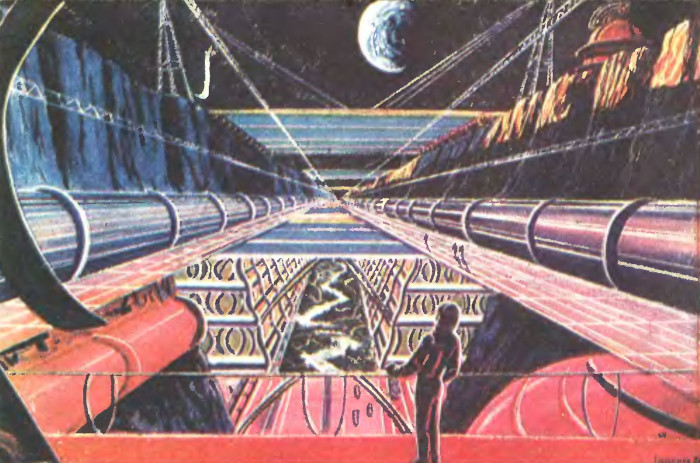 |
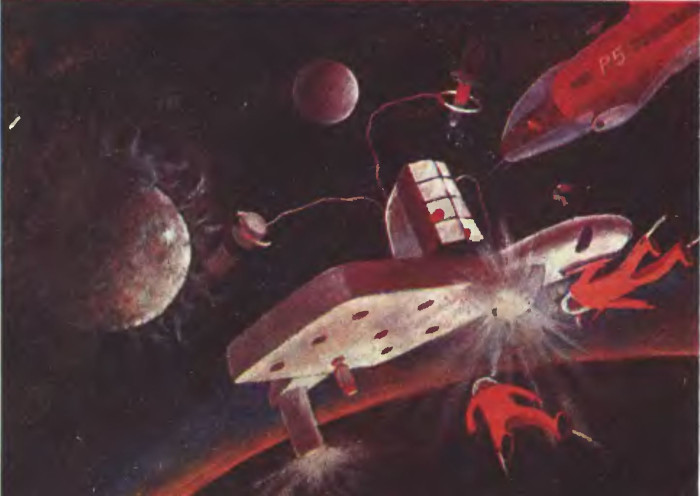
| This is how science-fiction artists G. TISHCHENKO (above) and V. BURMISTROV (below) envision future industrial enterprises on the Moon and in near-planetary orbits. |
 |
Not far from the residential districts will be scientific and administrative institutions. Industrial production, automated to such an extent that it requires no direct human intervention, is expediently placed in weightlessness—along the longitudinal axis of the astro-city, high above the heads of its inhabitants. Foundries and welding shops, powerful air-conditioning systems, and installations for water and air regeneration will be located here.
And the centers of the end sections of the rotating cylinder will be occupied by space terminals. From here, long-range interplanetary ships will depart, as well as cargo “ferries” carrying containers with the most valuable crystals and alloys back to Earth.
Across the entire outer surface of the astropolis (naturally, with the exception of the gigantic “windows”), solar panels will be laid to supply it with energy. And if at some moment their colossal area proves insufficient, a backup nuclear power plant located on the axis of the cylinder, near the industrial facilities, will come to the rescue. When energy is produced in excess, a powerful laser beam or a stream of high-frequency radiation will transmit this surplus to Earth.
Of course, there is no guarantee that astro-city builders will necessarily stop at this project. Other designs are possible as well. A cone with a transparent base constantly facing the Sun, or a long chain of 100-meter “beads” connected by a magnetic railway, perhaps even encircling a planet and closed into a ring like Saturn’s, or something even more unusual. One thing is clear—astro-cities will exist.
Not “tin cans for people,” but cities of light and joy, of happy labor and vibrant life—true companions of the beautiful Earth, the home planet to which one can always return after completing the planned work. Or simply fly back for a vacation.
And the centers of the end sections of the rotating cylinder will be occupied by space terminals. From here, long-range interplanetary ships will depart, as well as cargo “ferries” carrying containers with the most valuable crystals and alloys back to Earth.
Across the entire outer surface of the astropolis (naturally, with the exception of the gigantic “windows”), solar panels will be laid to supply it with energy. And if at some moment their colossal area proves insufficient, a backup nuclear power plant located on the axis of the cylinder, near the industrial facilities, will come to the rescue. When energy is produced in excess, a powerful laser beam or a stream of high-frequency radiation will transmit this surplus to Earth.
Of course, there is no guarantee that astro-city builders will necessarily stop at this project. Other designs are possible as well. A cone with a transparent base constantly facing the Sun, or a long chain of 100-meter “beads” connected by a magnetic railway, perhaps even encircling a planet and closed into a ring like Saturn’s, or something even more unusual. One thing is clear—astro-cities will exist.
Not “tin cans for people,” but cities of light and joy, of happy labor and vibrant life—true companions of the beautiful Earth, the home planet to which one can always return after completing the planned work. Or simply fly back for a vacation.
SETTLEMENTS ON SELENE
Humanity’s expansion into the universe will certainly not end with the creation of “ether cities” in the spirit of Tsiolkovsky. The second step on the ladder leading into infinity will undoubtedly be Earth’s eternal companion—the Moon. Already today, the first self-propelled vehicles—the Soviet Lunokhods and American crewed lunar rovers—have traversed the dead surface of this celestial body. And someday the first colony of the “settlers of Selene” will appear here. (As is known, this is one of the many names of the “silver sphere.”) Drawing on many years of Antarctic research experience, it is not difficult to envision it even now.
Work in Antarctica is not easy. Brutal frosts, sometimes reaching minus 80°C, the almost complete absence of any life, a continuous ice shell several kilometers thick... Nevertheless, enthusiasts from different countries of the world work here successfully. Insulated dwellings have been built in the ice, food and fuel depots constructed. Airfields have been cleared, and their own transport equipment adapted to local conditions has been developed.
The nature of the Moon is even harsher. Here the temperature drops at night to minus 150°C and rises during the day to plus 130°C. There is neither snow nor ice here—only dead rocks. Gentle mountains, meteorite impact craters, and relatively flat expanses of the “seas.”
And most importantly—there is neither air nor water on the Moon.
Yet even here it is possible to successfully build dwellings whose walls and roofs will protect humans from cold and heat, from meteorites and cosmic radiation.
Most likely, the first residential and working quarters will be located below ground level. Passing through a special airlock and freeing himself from his spacesuit, the lunar “winterer” will find himself in comfortable Earth-like conditions.
The local population will not lack energy—it will be supplied by nuclear and solar power plants. Self-propelled vehicles will travel across the crater-scarred plains, resembling both their “ancestor,” Lunokhod-1, and their Arctic and Antarctic “colleagues.” A small spaceport will be located next to the colony. In time, the Moon will also acquire its own industrial enterprises—it should be assumed that it is rich in mineral resources lying not far below the surface. It is these local metallurgical plants that will meet the needs of the orbital astro-cities.
Someday hundreds of thousands, or even millions, of people will live here. Many ancient cirques, covered with transparent domes, will turn into blooming oases. High-speed roads will link scattered outposts of human civilization into a single whole. And then, perhaps, the question will arise of creating a normal atmosphere here as well—for the power of humanity’s communist future is boundless. A new generation will replace the pioneers—native lunar inhabitants, true “selenites.” It is not impossible that they will even differ outwardly from us. And quite possibly it will be they who become the initiators of the transformation of other planets of the solar system.
But even when life on the Moon becomes easy and full-blooded, when its soil turns green and the sky overhead becomes blue from a restored atmosphere, even then the best and most beautiful of worlds will remain our Earth—the true cradle of humankind.
Work in Antarctica is not easy. Brutal frosts, sometimes reaching minus 80°C, the almost complete absence of any life, a continuous ice shell several kilometers thick... Nevertheless, enthusiasts from different countries of the world work here successfully. Insulated dwellings have been built in the ice, food and fuel depots constructed. Airfields have been cleared, and their own transport equipment adapted to local conditions has been developed.
The nature of the Moon is even harsher. Here the temperature drops at night to minus 150°C and rises during the day to plus 130°C. There is neither snow nor ice here—only dead rocks. Gentle mountains, meteorite impact craters, and relatively flat expanses of the “seas.”
And most importantly—there is neither air nor water on the Moon.
Yet even here it is possible to successfully build dwellings whose walls and roofs will protect humans from cold and heat, from meteorites and cosmic radiation.
Most likely, the first residential and working quarters will be located below ground level. Passing through a special airlock and freeing himself from his spacesuit, the lunar “winterer” will find himself in comfortable Earth-like conditions.
The local population will not lack energy—it will be supplied by nuclear and solar power plants. Self-propelled vehicles will travel across the crater-scarred plains, resembling both their “ancestor,” Lunokhod-1, and their Arctic and Antarctic “colleagues.” A small spaceport will be located next to the colony. In time, the Moon will also acquire its own industrial enterprises—it should be assumed that it is rich in mineral resources lying not far below the surface. It is these local metallurgical plants that will meet the needs of the orbital astro-cities.
Someday hundreds of thousands, or even millions, of people will live here. Many ancient cirques, covered with transparent domes, will turn into blooming oases. High-speed roads will link scattered outposts of human civilization into a single whole. And then, perhaps, the question will arise of creating a normal atmosphere here as well—for the power of humanity’s communist future is boundless. A new generation will replace the pioneers—native lunar inhabitants, true “selenites.” It is not impossible that they will even differ outwardly from us. And quite possibly it will be they who become the initiators of the transformation of other planets of the solar system.
But even when life on the Moon becomes easy and full-blooded, when its soil turns green and the sky overhead becomes blue from a restored atmosphere, even then the best and most beautiful of worlds will remain our Earth—the true cradle of humankind.
VASILY DMITRIEV