


...The morning of September 15, 1916, for the German soldiers stationed near the village of Flers-Courcelette, on the banks of the Somme River, seemed to promise nothing unusual.
Since late July, the British had been trying to break through German positions, but without success. It was true hell: a rain of shells fell on every meter of the front! But as soon as thick lines of British infantry emerged from their trenches and moved forward, German soldiers would climb out of their dugouts and set up machine guns. The advancing attackers were defenseless, and the machine-gun bursts mowed them down by the hundreds. Sometimes the "Tommies" managed to advance a few hundred meters, but almost always at a very high cost. What prevented the numerous regiments from achieving decisive success? Trenches, barbed wire barriers, and most of all — the machine gun, which reigned supreme on the battlefields at that time. The enormous losses forced soldiers to literally dig themselves into the ground. As a result, the front turned into a continuous "frozen" trench line — from the English Channel to Switzerland.
The warring sides tried to break the deadlock, primarily using artillery. But even massive artillery barrages could not wipe out all enemy soldiers. This inability of offensive means to overcome defensive ones was called a "positional deadlock."
The German soldiers knew that if they could endure the artillery barrage and wait for the enemy to attack, the machine gun would do the job.
But that morning, the Germans saw strange machines slowly moving from the British positions across the pockmarked field, accompanied by infantry. Upon the first encounter, it became clear that these monsters were immune to bullets. Panic swept through the Germans.
These bulky and slow-moving machines were the first tanks ever tested in battle. They moved in formation with infantry, crossed trenches and barbed wire, and suppressed enemy machine guns. A total of 18 vehicles took part in the attack. And yet, in just a few hours over a front 5 km wide, they advanced 5 km deep. This was the breakthrough from the "positional deadlock"!
...In October 1914, British Colonel E.D. Swinton submitted a proposal for such a machine to the War Office. After long delays, his idea was approved. In September 1915, the first British combat vehicle, "Little Willie," was tested — named after the engineer Wilson. Essentially, it was an armored tractor. On September 28, a different version — "Big Willie" — was tested. It became the prototype for the first British combat tank. It was tested on January 30, 1916, and adopted under the designation Mk I.
During World War I, the British mainly built heavy tanks (weighing over 20 tons) with a unique design. These machines had to overcome not only wide trenches, craters, and shell holes, but also vertical obstacles. Therefore, the tank tracks had a very large contact surface and a considerable height of grip, which is why British tanks had tracks that wrapped around the body. With this layout, the weapons were placed only in the sides between the upper and lower tracks. To enable the guns and machine guns to fire forward or backward, the designers positioned them in side turrets (sponsons).
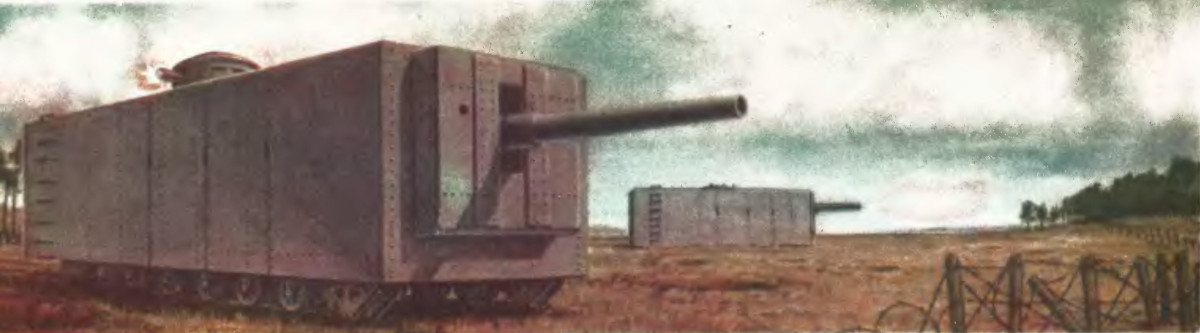
Project of a super-heavy tank by engineer V.D. Mendeleev
Although the first actual combat-tested tank was British, the idea itself belonged to Russian engineer V.D. Mendeleev (1886–1922). His vehicle weighed 170 tons, was armed with a 120 mm cannon, and protected by 150 mm of armor. This project, proposed in 1911, was never approved by the Imperial Army's technical committee.
The Mk I tank was clumsy. A two-wheeled cart (the so-called tail wheels) was attached to the rear of the hull. By tightening cables from inside the tank, the cart would turn, causing the whole machine to steer.
The following models — Mk II and Mk III — no longer had tail wheels, but driving them remained very difficult. No wonder each tank required not only four gunners but also four other crew members: a driver, a commander who operated the track brakes, and two transmission men (working on the side gearboxes).
Starting in April 1917, Mk IV tanks began entering service, featuring more powerful armor. This was because the Germans responded with armor-piercing bullets.
After the battle on the Somme, the British used tanks several more times, but in small numbers, and the terrain was not always ideal for tank attacks. As a result, the new machines couldn’t demonstrate their full capabilities. Unsurprisingly, tanks gained many critics who demanded an end to the expensive experiments. The existence of armored forces was in question. British Brigadier General Ellis understood this clearly, which is why, at dawn on November 20, 1917, he personally led his tank troops into battle.
The operation took place near Cambrai — a town in northern France. To break through the German “Hindenburg Line,” six infantry divisions and three tank brigades (378 vehicles) were secretly concentrated here. For the first time, suitable (tank-accessible) terrain was selected, and the tanks were used in mass numbers. The attack began unexpectedly. Soon, the front was breached by 16 km. Within a few hours, the British advanced 9 km deep. It was a great success. Thus, tanks earned their recognition and helped the British break out of the “positional deadlock.”
By the end of the war, the British managed to produce the Mk V tanks. These were equipped with a 4-speed planetary gearbox (developed by Wilson) and a special Ricardo tank engine. Now the vehicle could be operated by just one person — there was no longer a need for separate side transmissions.
The Germans began building wide (up to 4 m) anti-tank ditches. In response, British military engineers increased the length of the tanks.
The pinnacle of World War I heavy tanks was the Mk VIII. It had a very long hull. However, only seven units were produced before the end of the war, and they never saw combat.
The Mk IV and Mk V tanks were the main British tanks of World War I. Mk V tanks, used by White forces and interventionists, fought on Soviet soil. Several were captured by the Red Army and remained in service under the name “Ricardo tanks” until 1930.
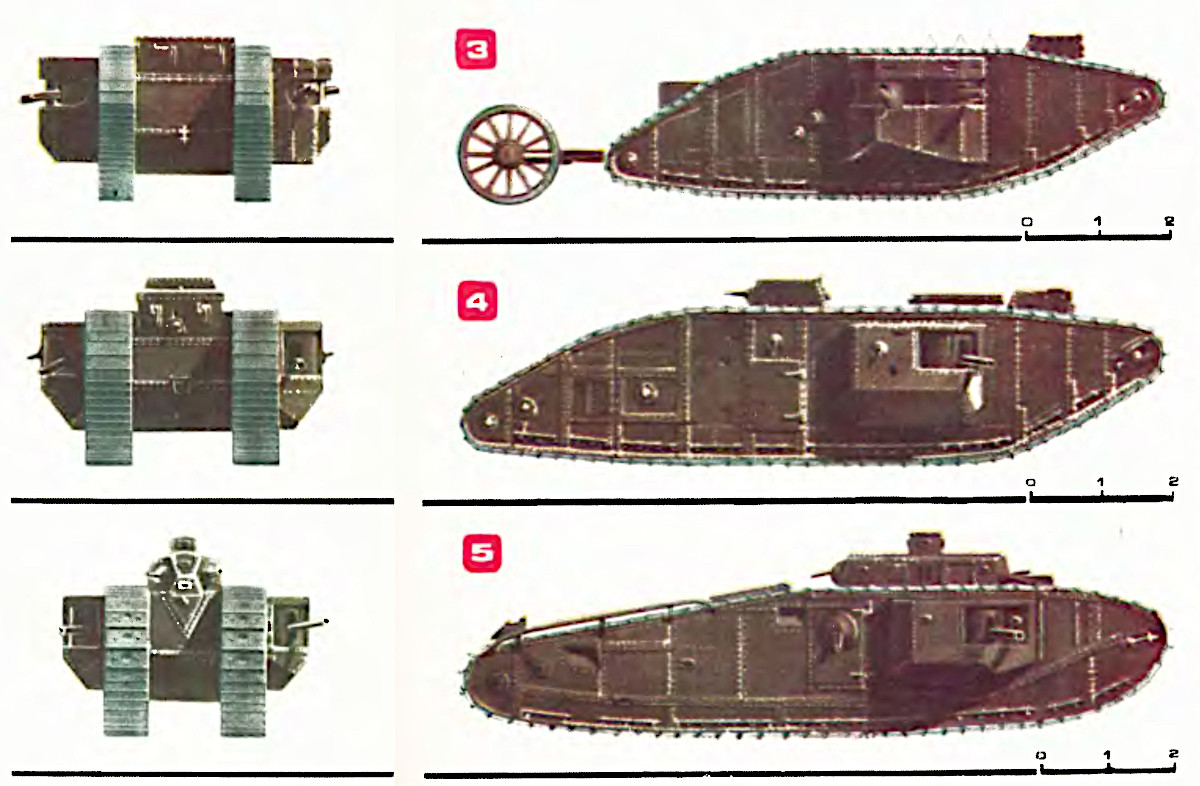
3. British heavy tank Mk I. Combat weight – 28.4 tonnes. Crew – 8 people. Armament – 5 machine guns. Armor thickness – 12 mm front, 10 mm sides. Engine – “Daimler,” 105 hp. Road speed – 6 km/h. Range – 37 km.
4. British heavy tank Mk V. Combat weight – 34 tonnes. Crew – 8 people. Armament – two 57 mm guns, 4 machine guns. Armor thickness – 15 mm front, 10 mm sides. Engine – “Ricardo,” 150 hp. Road speed – 7.5 km/h. Range – 64 km.
5. Anglo-American tank Mk VIII. Combat weight – 39 tonnes. Crew – 8 people. Armament – two 57 mm guns, 5 machine guns. Armor thickness – 16 mm front and sides. Engine – “Liberty,” 338 hp. Road speed – 13 km/h. Range – 80 km.
Above: Mendeleev’s tank. Combat weight – 173 tonnes. Crew – 8 people. Armament – one 120 mm gun, one machine gun. Armor thickness – 150 mm front, 100 mm sides. Engine power – 250 hp. Road speed – 24 km/h.