


The next stage in the history of artillery is associated with the name of an outstanding Russian statesman and military figure of the Elizabethan era, General-Fieldmaster Shuvalov (1710–1762).
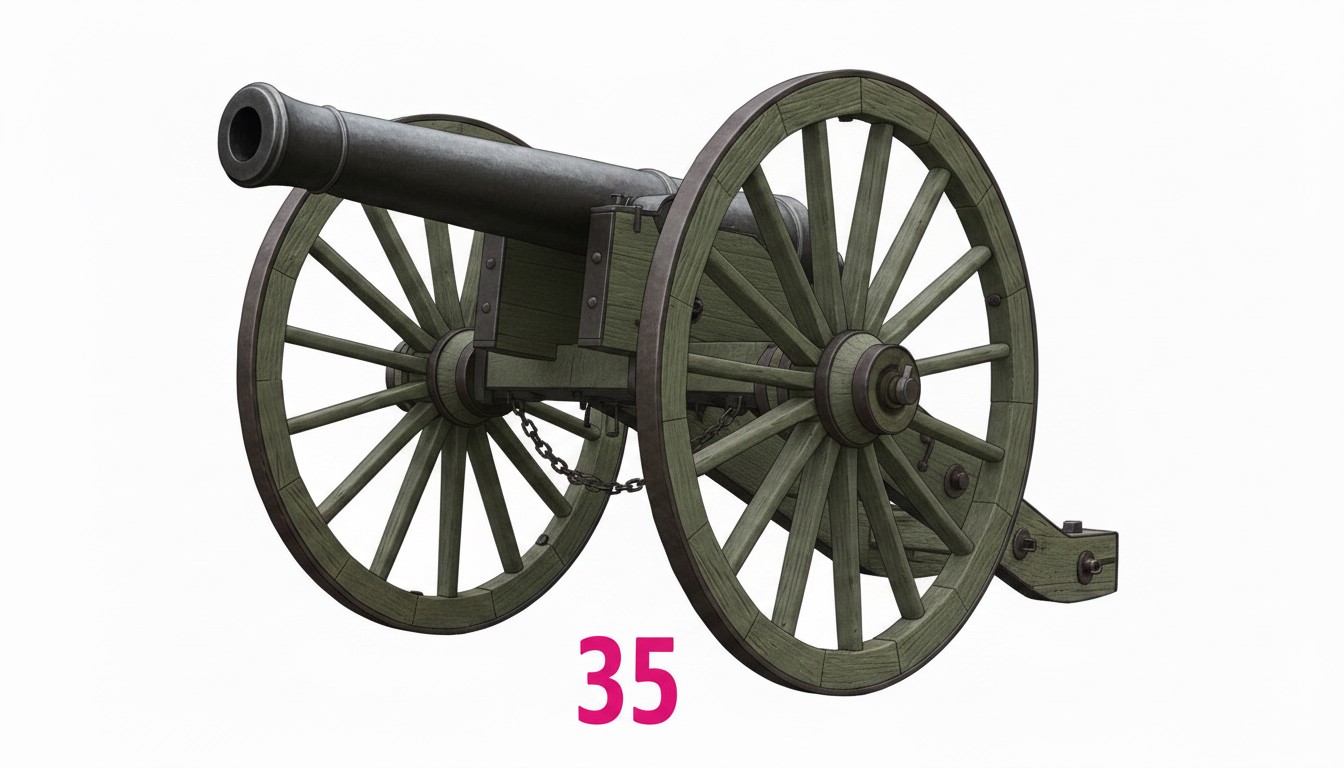 |
| 35. "Secret Howitzer" with an oval barrel, created by Major Musin-Pushkin and master Stepanov. |
A representative of the second generation of "Peter the Great's nestlings," he, like his predecessors, fully supported and encouraged the activities of domestic scientists, officers, and craftsmen aimed at strengthening the combat effectiveness of the troops. On his initiative, in the mid-18th century, remarkable artillery pieces were adopted for service, the likes of which no European army knew. And this was done in a very unique way – before the start and during the Seven Years' War of 1756–1763, in which the Russian army encountered the superbly trained troops of Prussian King Frederick II.
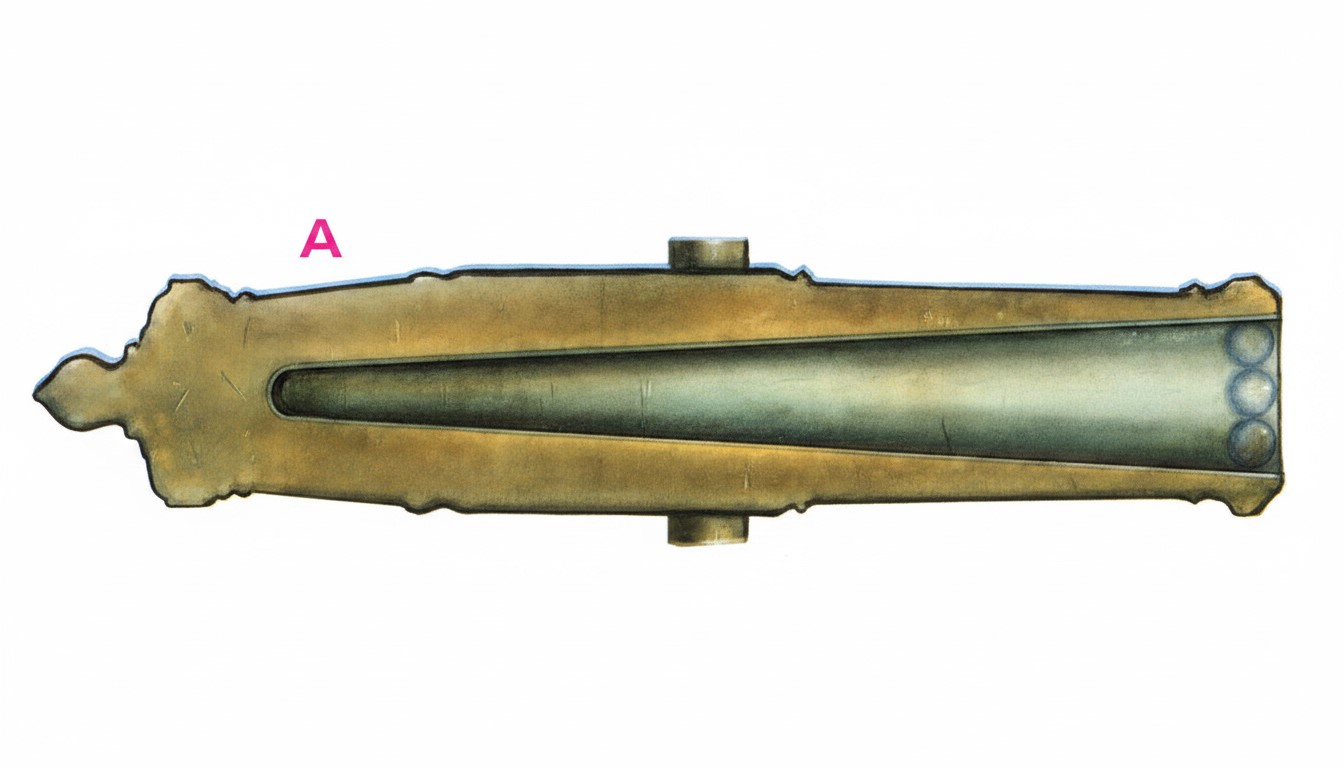 |
| A. Design of the "secret howitzer" barrel. |
As early as the end of 1756, Captains Rozhnov and Zhukov created six-, eight-, and twelve-pound cannons. The shortened barrels of these "new inventory" guns had a flared muzzle. Thanks to this design feature, artillerymen could fire any type of projectile.
A year later, Lieutenant Colonel Martynov and Captain Danilov developed, to replace the obsolete three-pound regimental gun, not a similar but improved weapon, but an original system. It consisted of two barrels mounted on a single carriage. This innovation made it possible to double the density of fire of the batteries.
Shuvalov paid particular attention to the development of howitzers – a new type of artillery piece at that time. Their advantage lay in the fact that howitzers could fire both direct fire, like cannons, and plunging fire, like mortars. Therefore, howitzers can rightly be considered the prototype of universal artillery pieces.
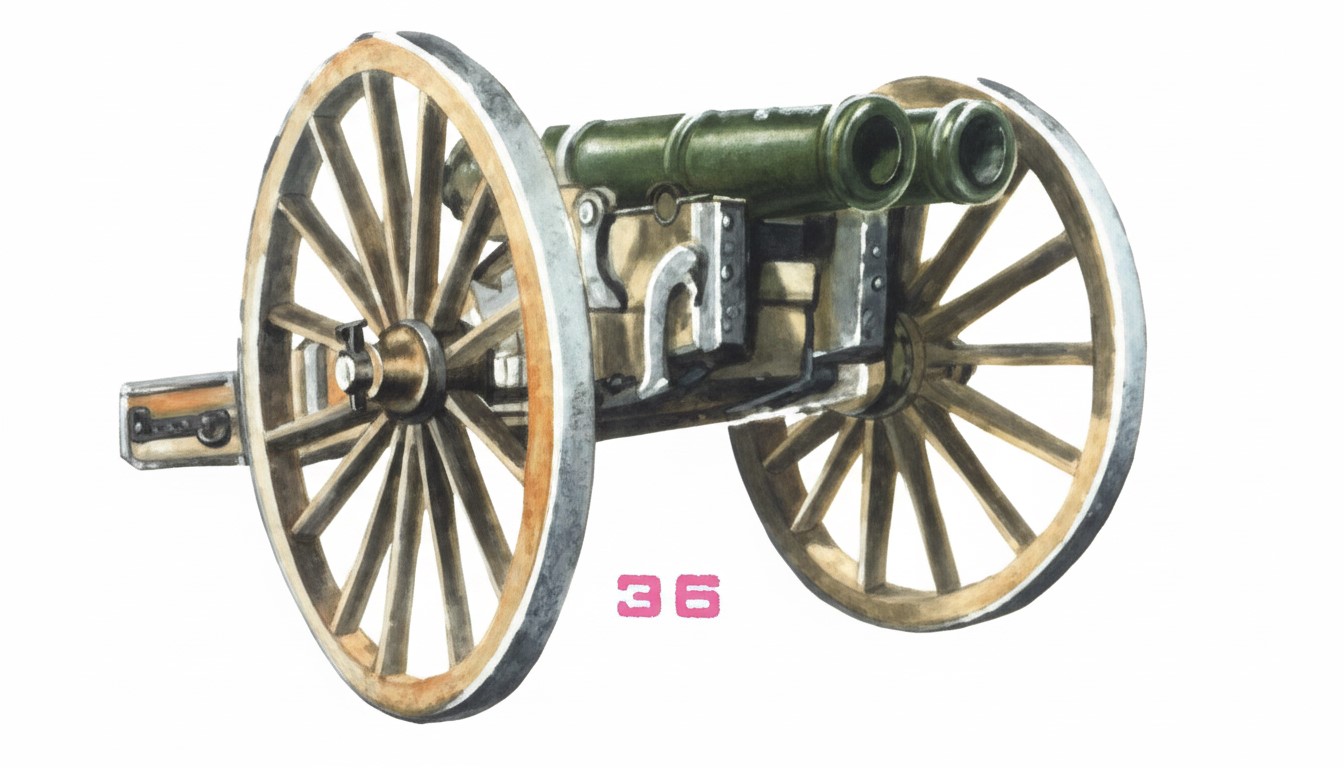 |
| 36. "Twins" – a twin-barreled gun intended for fighting infantry and cavalry. |
Three years before the Seven Years' War, Shuvalov proposed the idea of a new type of howitzer intended for fighting infantry and cavalry. Its development was entrusted to Major Musin-Pushkin and master Stepanov, and by 1754 these guns began to enter the regiments. At first, they were kept in great secrecy, and outside the camps, the crews had to cover the muzzle with tarpaulins so that overly curious foreigners would not learn the secrets of their design.
 |
| B. This is what the diopter – a sighting device developed by Colonel Tyutchev – looked like. |
The artillerymen had something to hide – the barrel's bore widened horizontally to three calibers towards the muzzle. Therefore, upon firing, the grapeshot spread out like a fan, striking the densely packed battalions and squadrons of the enemy. In 1756, the "secret howitzers" replaced the wooden wedge previously placed under the barrel with a metal mechanism for vertical aiming. A little over a year later, after the victory over Frederick II at Gross-Jägersdorf, Field Marshal Apraksin reported on the "great effect of the secret howitzers newly invented by General-Fieldmaster Count Shuvalov."
Meanwhile, the creators of the twin-barreled "Twins," Martynov and Danilov, began developing a "new kind" howitzer with an elongated barrel and a conical powder chamber. By 1757, the army had received five variants of the "unicorns" – the howitzers owed this name to the mythical beast that adorned the Shuvalov family coat of arms.
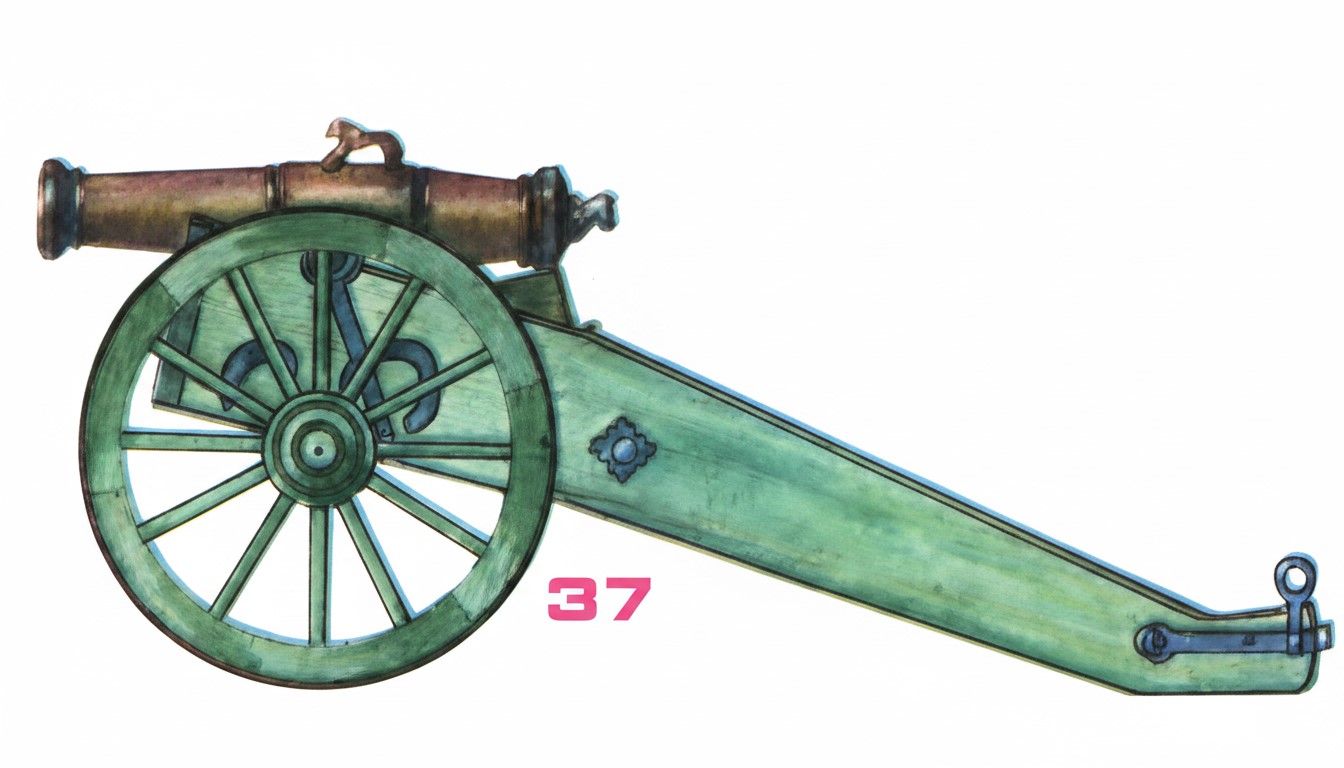 |
| 37. Half-pood "unicorn," cast in 1757. |
The barrel diameter of the "unicorns" ranged from 95 to 245 mm, barrels 7.5–9 calibers long weighed from 6 to 90 poods, and the weight of grapeshot, cannonballs, explosive grenades, or incendiary projectiles ranged (depending on the type of gun) from one and a half to twelve pounds. Thanks to their elongated barrels, the "unicorns" could fire at a distance of 3 km, and with the barrel elevated to 45°, almost twice as far – by 18th-century standards, an excellent result! As for density, accuracy of fire, and maneuverability, the light and therefore mobile "unicorns" surpassed all contemporary artillery systems in the world.
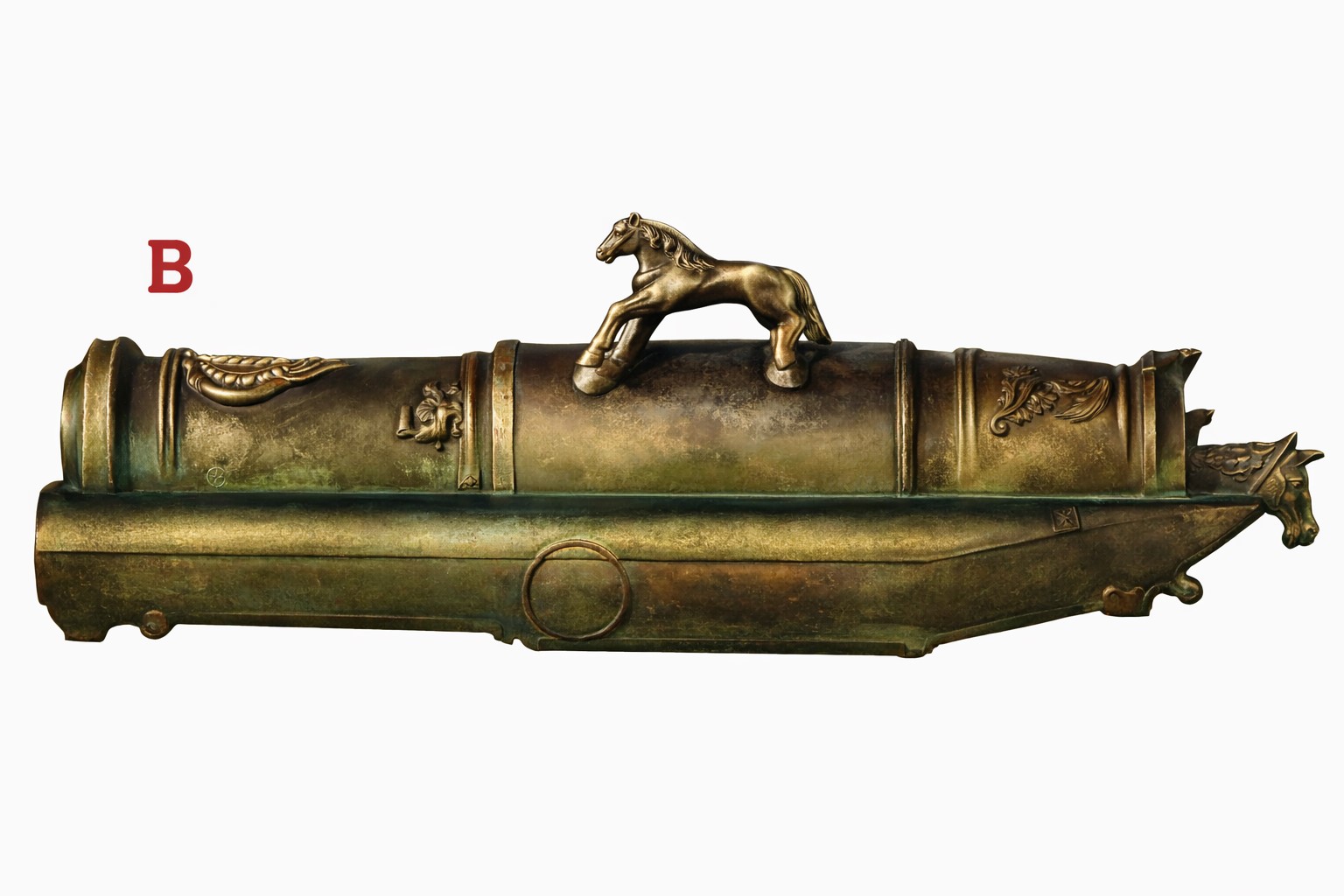 |
| C. Cross-section of the "unicorn" barrel. |
The long-barreled howitzers passed their combat test in the Seven Years' War. In 1759, at the Battle of Paltzig, Russian artillerymen unexpectedly opened fire on the enemy over the heads of their own troops for the first time in the world! Reporting the same year on the victory over Frederick II at Kunersdorf, General-in-Chief Saltykov informed Empress Elizabeth that "our artillery, especially the large one... with its new-inventory guns and Shuvalov howitzers, caused great harm to the enemy cavalry and opposing batteries."
The 1st Artillery Regiment, which distinguished itself in the war, received an unusual award – a kettledrum carriage made according to a design by the architect Rastrelli. Decorated with carvings and gilding, with trophy cannons on its wheels, it was used for the ceremonial presentation of the regimental banner bearing the inscription: "It guards and terrifies." The kettledrum carriage is now on display at the Military Historical Museum of Artillery, Engineer and Signal Corps in Leningrad.
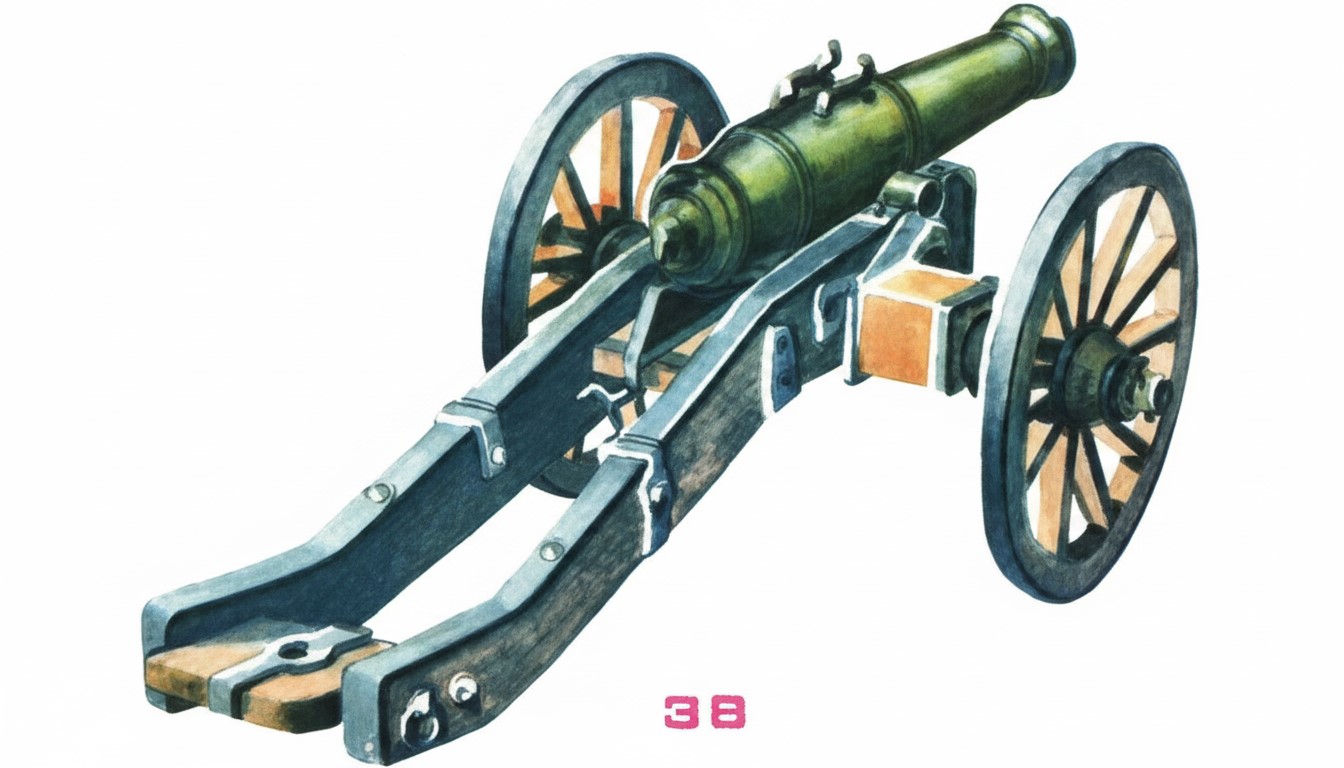 |
| 38. Eight-pound "unicorn" on the carriage of an experimental gun. |
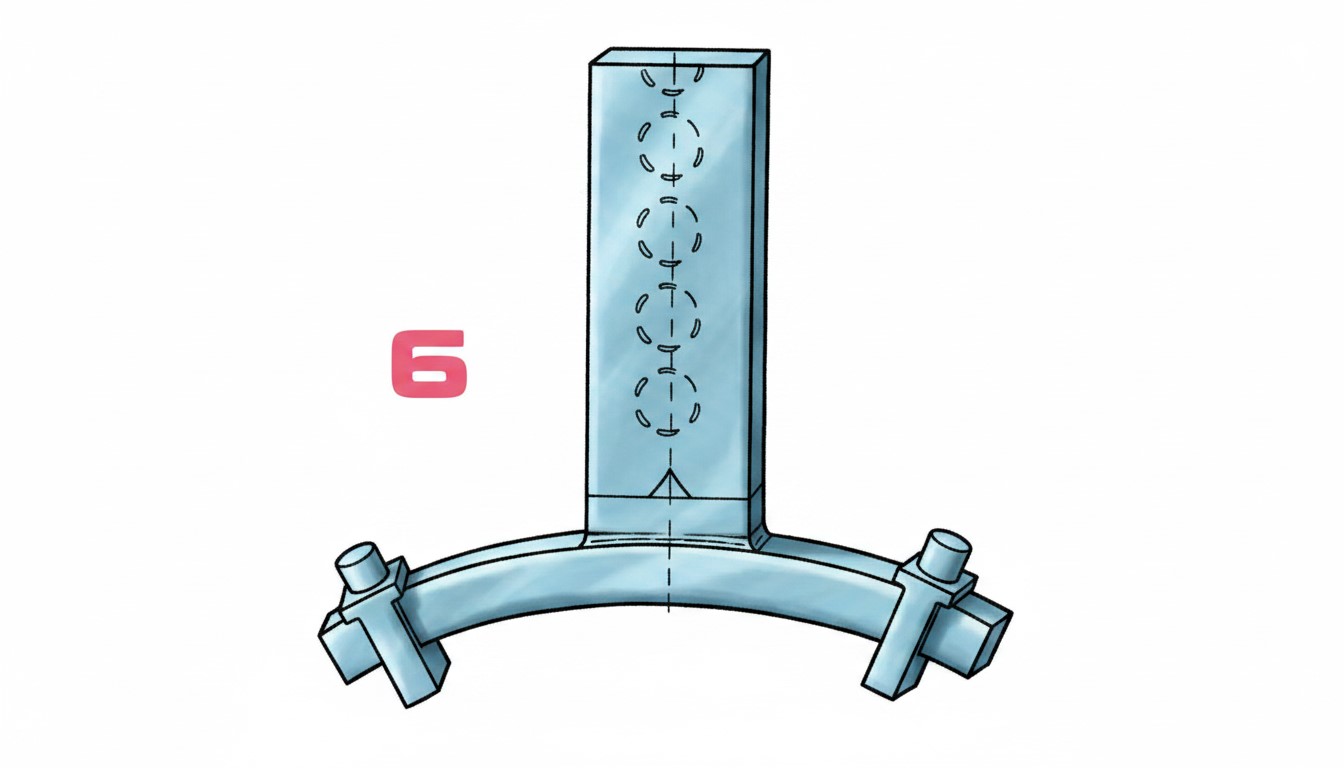
After their baptism by fire, the "unicorns" were modernized. Their barrels were further elongated, carriages strengthened, and from 1759, the Shuvalov howitzers began to be equipped with a more effective sighting device than a notch and front sight – a diopter created by Colonel Tyutchev.
The Shuvalov "unicorns," which embodied the many years of experience of domestic gunsmiths and the latest achievements of science and technology of that time, became the standard. Abroad, so-called "long howitzers" were cast based on their model. As for the Russian "unicorns," they went on to take part in Suvorov's campaigns and smash Napoleon's divisions during the Patriotic War of 1812. Few people know that the Shuvalov howitzers remained in service with fortress artillery until 1906 (!).
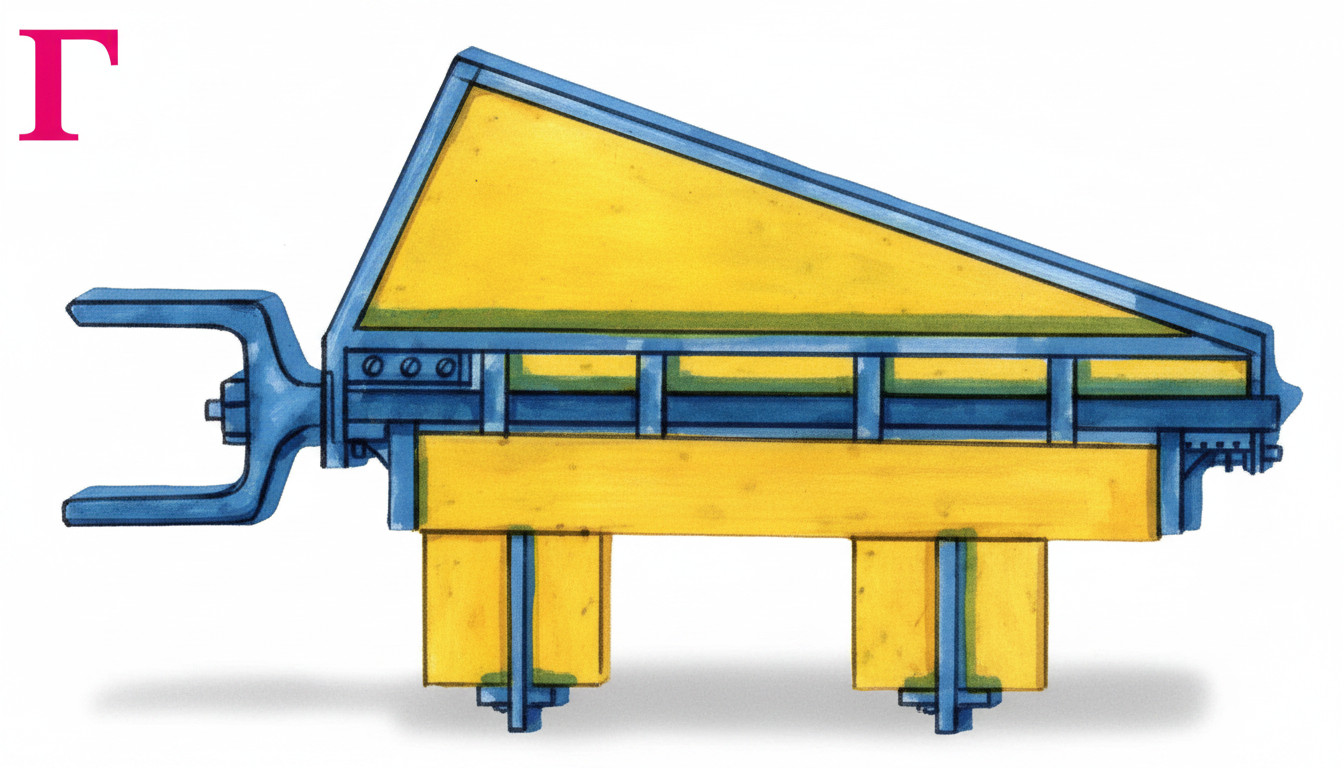 |
| D. Wedge-type vertical aiming mechanism with a horizontal screw, which was used to equip the Shuvalov howitzers from 1760. |
…Having introduced new artillery systems into the army, Shuvalov also cared about developing new types of ammunition. For example, to increase the range and accuracy of fire, ordinary gunpowder in the "unicorns" was replaced with fine-grained musket powder, and grapeshot and grenades began to be placed in the same cartridge case as the powder. This innovation made it possible to significantly speed up the loading of guns.
Shuvalov also did much for personnel training. He repeatedly emphasized that "artillery and the engineer corps, being founded on science, must be supplied with highly scientific officers."
To this end, a short artillery regulation was issued in 1756, and six years later, Captain Danilov published a textbook entitled "Elementary Knowledge of the Theory and Practice of Artillery."
Prominent Russian military commanders Rumyantsev, Saltykov, and Suvorov devoted considerable attention to developing the fundamentals of artillery tactics on the battlefield. In particular, while still a lieutenant colonel, Suvorov participated in several battles of the Seven Years' War. He concluded that it was necessary to concentrate artillery in the direction of the main attack.
Before a battle, Suvorov positioned his cannons in front of the infantry, so that after weakening the enemy battalions with artillery fire, he could complete the rout with a bayonet charge. Thus, in 1790, before the assault on the Turkish fortress of Izmail, Suvorov concentrated the bulk of his artillery – about 600 guns – in the direction of the main attack and, after intensive bombardment, took the fortress by open assault.
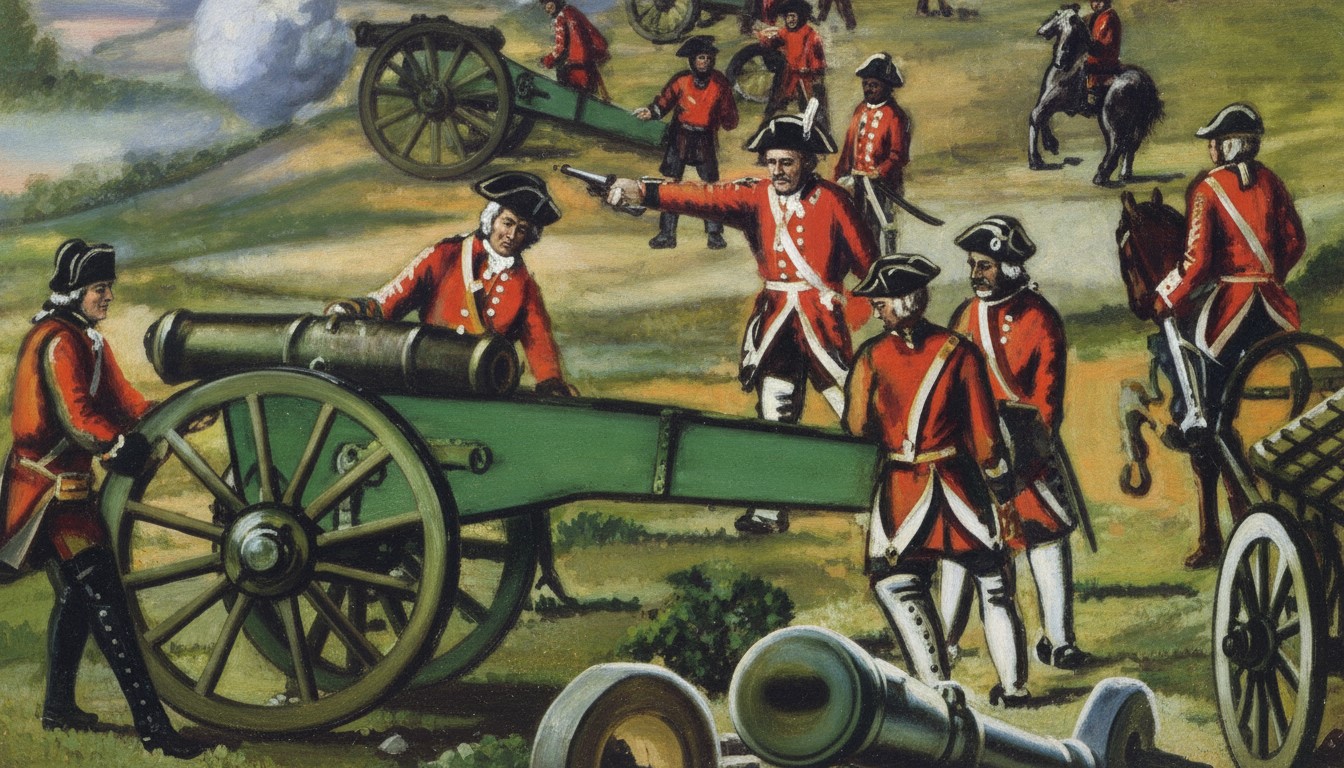
Headpiece: Russian artillerymen in battle against the Prussian army at Kunersdorf on August 1, 1759.