


Europeans turned out to be capable students of the overseas "touring performers"—the Wright brothers. Carrying out orders from the famous car racer Henri Farman, the firm "Voisin Brothers" built him several successful airplanes.
On one of the machines, Farman applied the Wrights' principle of lateral control—with the only difference being that the role of the wing warping was played by flaps-ailerons. Wealthy manufacturer Louis Blériot created several new monoplane designs. Using the "tandem" scheme (two wings placed one behind the other in the same plane) of American professor Samuel Langley as a basis, Blériot gradually reduced the size of the rear wing, transforming it into a horizontal tail unit. Athlete Hubert Latham, also on a monoplane built by the "Antoinette" motor company, broke all the records of European aviators in the spring of 1909: flight duration exceeded an hour. The range already reached several dozen kilometers, and the speed came close to 80 km/h. Foreseeing the course of events, the English newspaper *Daily Mail* announced a prize of 1,000 pounds sterling for the first person to fly across the English Channel. Latham and Blériot accepted the challenge.
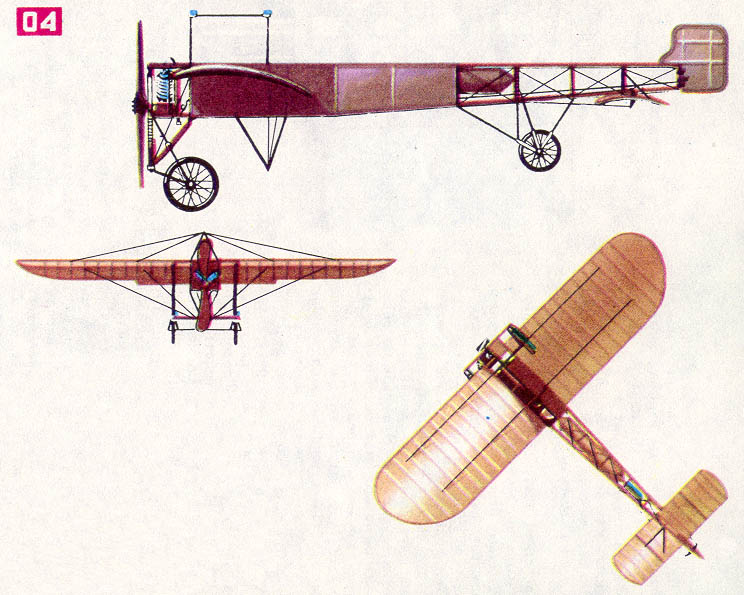 |
| 4. "Blériot XI" (France, 1909). Engine—"Anzani," 25 hp. Flight weight—320 kg. Wing area—14 m². Wingspan—7.2 m. Speed—70 km/h. |
On July 19, 1909, Latham took off in the elegant long-winged "Antoinette" but failed. A few miles from the English shore, the engine failed. The pilot and the machine were fished out of the water by the crew of a French ship and returned to the mainland.
A week later, Blériot took to the air in his "Type XI." The fate of the pilot and the 1,000-pound prize depended on the weak 25-horsepower engine, carefully tuned by Blériot himself.
One of the first air-cooled engines, the "Anzani," worked for only 20-25 minutes before overheating and seizing. The pilot planned to complete the flight in 18 minutes.
The engine did not fail, even though the historic flight lasted a full 33 minutes. Louis Blériot did not break any records but rightly became a national hero of France. He proved that a flying machine could cross bodies of water and serve as a means of transportation, not just entertain crowds by soaring around the Eiffel Tower. "No more straits!", "A bridge over the Channel!", "Great Britain is part of the continent!" proclaimed newspaper headlines.
France, which gave the world a whole generation of pilots and engineers, became the Mecca of European aviation, and Paris—the "aviary" (as newspapers dubbed it)—welcomed aspiring pilots from all over the world. In just two years (1909–1910), the French Aero Club issued 354 certificates of flight training completion. To the credit of our compatriots, they accounted for 27 of these documents, compared to 19 for the English, 7 for the Dutch, and 4 for the Germans. Among the first graduates of the Paris school were the famous Russian pilots N. Popov, M. Efimov, and I. Zaikin.
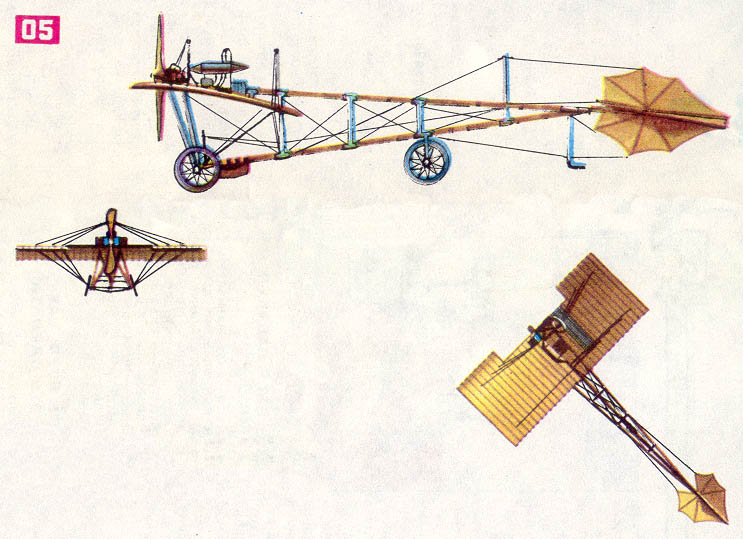 |
| 5. "Demoiselle" (France, 1909). Designer — A. Santos-Dumont. Engine — "Darracq," 30 hp. Flight weight — 120 kg. Wing area — 9.5 m². Wingspan — 5.5 m. Speed — 90 km/h. |
The abilities of those who held pilot licenses were best demonstrated by Article 1 of the "Rules for Obtaining the Title of Pilot in France": the candidate had to fly "three full circles, each at least 1 km in length, without touching the ground. These circles had to be completed by the candidate without passengers, on different days, and within a maximum of 30 days." That was all. Is it any wonder at the number of injured or deceased pilots, which was quite comparable to the number of Aero Club graduates?
On this topic, the Russian journal *Vozdukhoplavatel* wrote: "From the beginning of 1908 to January 1, 1912, 112 people fell victim to the idea of aviation..."
Accidents and disasters were a harsh but inevitable price for the establishment of a new field of science and technology—aviation. Feeling like masters of the elements, aviators tried to break previous records of distance, duration, and altitude on airplanes suitable only for timid ascents above airfields.
Bad weather turned out to be a fearsome enemy of aviators. Not only did turbulence reveal weaknesses in the structures, but sudden gusts knocked planes out of their usual horizontal positions, tilted them, and put pilots in extremely difficult situations not addressed in manuals. As one aviator of the time remarked, "In case of a whirlwind coming from behind, the only thing left to do is to imitate Harlequin falling from his bell tower and pray to God for it to last long."
It is hard to believe now that many, even those experienced in aviation, dismissed the sensational flights of French aviator Pegoud in 1913 as meaningless acrobatic stunts. Contrary to theories about "critical angles" and "angles of death," the daring pilot demonstrated the most incredible maneuvers with his "Blériot." The machine flew upside down, dived, and climbed steeply. Pegoud proved that, with sufficient altitude, a plane could be recovered from any position.
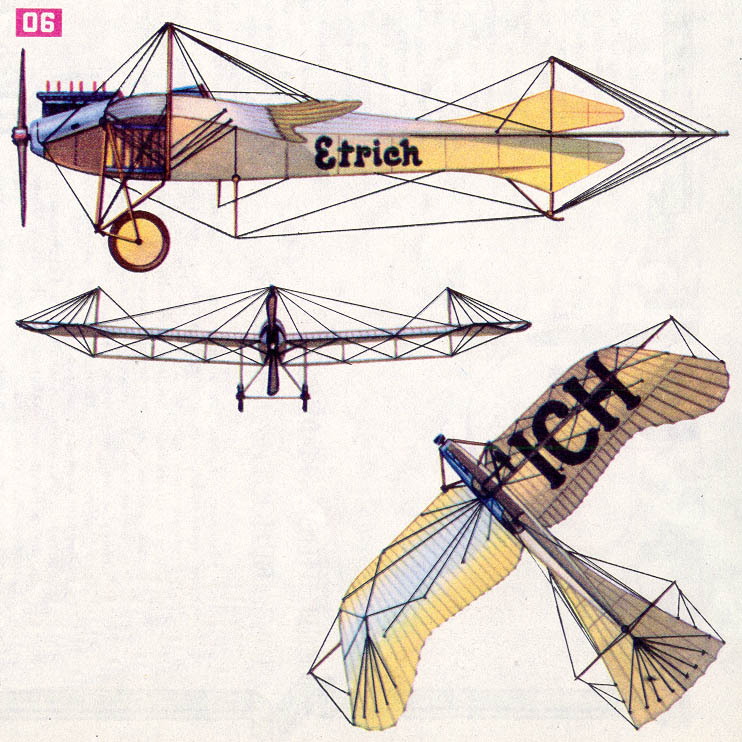 |
| 6. "Etrich Taube" (Austria, 1910). Designer — I. Etrich. Engine — "Daimler," 60 hp. Flight weight — 500 kg. Wing area — 38 m². Wingspan — 14.30 m. Speed — 70 km/h. |
An outstanding pilot and a shrewd businessman, Pegoud could not complain about a lack of attention from the public, the press, or patrons. Quite different was the fate of our renowned compatriot, military pilot Pyotr Nikolayevich Nesterov. Starting his experiments simultaneously with Pegoud, Nesterov went further and, for the first time in aviation history, on August 23, 1913, performed a closed loop in the vertical plane on an airplane. The "loop-the-loop" did not bring Nesterov profit or fame in his homeland; he declined offers from French entrepreneurs to perform abroad. A remarkable pilot and patriot, he aimed to expand the maneuvering capabilities of airplanes and to create aircraft designed for real aerial combat.
The skill and bravery of another Russian pilot, Konstantin Konstantinovich Artseulov (still living and for many years contributing as an artist to our magazine), earned global aviation its victory over aviators' mortal enemy—the spin. On September 24, 1916, Artseulov was the first to deliberately put an aircraft into this condition and, contrary to claims about the uncontrollability of spins, successfully recovered it...
Through the combined efforts of designers, pilots, and entrepreneurs, the airplane gained features that made it suitable for a variety of practical tasks.
Austrian designer Etrich, by rejecting the use of various gyroscopic devices, endowed the aircraft itself with stability. The shape of its wing resembled the configuration of the seed of the tropical plant zanonia. An aircraft with such a bearing surface possessed inherent longitudinal balance and stability.
The outbreak of World War I in 1914 quickly shaped nearly all types of aircraft. In the very first months of hostilities, aviation undertook operations that were previously considered exceptional, even stunt-like, or merely dreamed of by pioneers of dynamic flight.
On the title screen: "Nieuport-1" (France, 1910). Engine — "Nieuport," 30 hp. Flight weight — 310 kg. Wing area — 14 m². Wingspan — 8.4 m. Speed — 105 km/h. One of the first models by the outstanding aircraft designer Edouard Nieuport.