


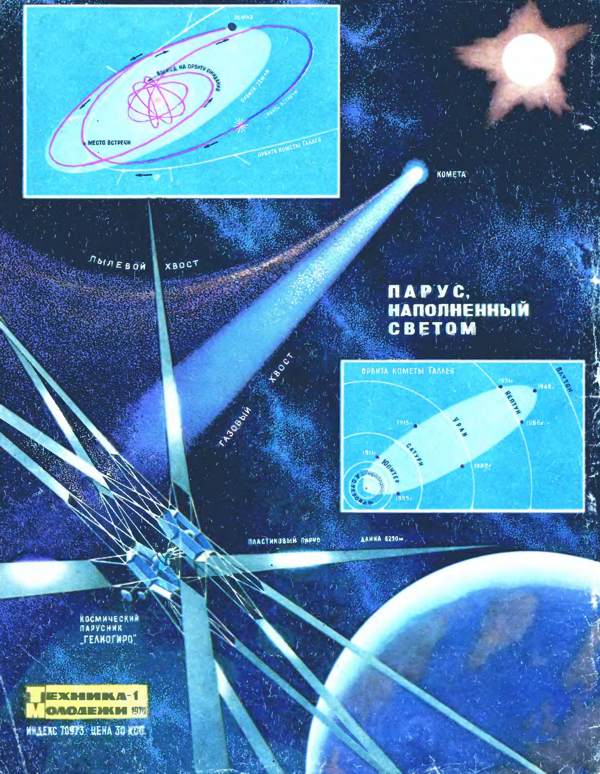
In 1980, 12 plastic petals with a total area of 600,000 m2 will unfold in space at a distance of 100,000 km from Earth. The solar wind will fill the sails, and "Heliogiro," a space sailboat, will begin its journey toward Halley's Comet.
Not long ago, in 1969, the magazine's pages discussed projects for sail-powered spacecraft, considered the technical challenges to be solved, and outlined flight goals (“TM,” No. 8, 1969). Less than ten years later, as has often happened, science fiction is becoming a reality. Almost all technical issues related to the construction of a solar sail have been resolved, and the goal of the first flight has been set — Halley's Comet.
One of the brightest representatives of celestial wanderers, the comet was named after Newton's friend and student Edmund Halley, who predicted its appearance in 1758. Halley's prediction was brilliantly confirmed: after difficult calculations of the disturbing effects of planets and the location of the comet in the sky, it was discovered at the end of 1758 and passed through perihelion in March 1759, with an error of less than a month. The comet provided the first unequivocal confirmation of the universality of the law of universal gravitation and the power of celestial mechanics developed at that time.
Comets are small bodies in the solar system. Their sizes are much smaller than the smallest satellites of the solar planets. However, unlike meteoroids, which consist mainly of solid material, comets contain significantly more volatile components. Mainly, these are frozen methane-ammonia compounds. When a comet approaches the Sun, part of its nucleus, in the conditions of cosmic vacuum, turns into a gaseous state under the influence of solar rays, bypassing the liquid phase.
Powerful jets of glowing comet material erupt from the comet’s nucleus in all directions and, bending under the influence of solar rays, form the head, which then flows into the tail. Observations have shown that Halley's Comet ejects 4 tons of gas per second from its nucleus at a distance of one astronomical unit from the Sun!
The comet's head, expanding, can become larger than the Sun, and its tail, always directed away from the Sun, sometimes stretches for millions of kilometers.
Despite their gigantic sizes, the density of material in comets is negligible. Disperse one grain of wheat in the volume of the Bolshoi Theater, and you will get an idea of the density of material in a comet.
Unfortunately, besides the information about the composition of comet material obtained through spectroscopy, little is known about these mysterious wanderers.
Where do comets come from, and where do they disappear to? Where are they born, and how do they die? Why do many comets periodically return to the Sun?
Soviet scientist S. Vsekhsvyatsky supports the hypothesis that comets are still formed today through volcanic eruptions on giant planets and their moons. Dutch astronomer Oort's hypothesis suggests that comets form a ring of remnants of the protoplanetary cloud somewhere beyond Pluto's orbit. Under the influence of perturbations from nearby stars, some comets are thrown into the inner regions of the solar system and become visible. French astronomers believe the primary source of cometary material could also be the Sun itself. Matter streaming as the solar wind reaches the region in space where interplanetary magnetic fields collide with interstellar magnetic fields, creating turbulence. Here, whirlwinds gather material into clumps, which continuously grow in size. When these clumps reach a certain size, the Sun’s gravitational pull overcomes resisting forces, and the seeds of future comets start back toward their "parent."
Who is right? Perhaps the data collected by the first solar sail-powered spacecraft, "Heliogiro," will help answer many questions about the origin and composition of comets.
The idea of creating a spacecraft powered by the solar wind was proposed by Tsiolkovsky in 1920.
According to modern understanding, the solar wind consists of streams of particles — electrically charged particles continuously emitted by the solar corona.
According to data from interplanetary stations, the solar wind speed reaches 400 km/s near Earth, and turbulence in the gas and deformation of the magnetic field it carries can be observed in its streams.
It was decided to use the solar wind for flights in near-solar space.
According to experts from NASA's Space Flight Center, who developed the project jointly with the Jet Propulsion Laboratory in Pasadena (USA), the solar sail spacecraft can perform a variety of tasks in the solar system. This spacecraft is designed for long-duration flights with small but constant acceleration.
Where does this acceleration come from?
In 1900, Russian physicist P. Lebedev experimentally proved that light can exert pressure on objects. For example, on Earth at noon, the Sun exerts a pressure of 4.6 × 10⁻⁶ newtons per mg on a perfectly reflective surface, meaning that on one square kilometer of perfectly polished aluminum, solar radiation would exert a force of 0.5 kg. However, as the object gets closer to the Sun, this force increases and, most importantly, acts continuously. Thus, despite the small magnitude of acceleration, over many months of flight, the speed of the solar sail spacecraft, according to NASA engineers' calculations, will reach 200,000 km/h by the time it meets Halley's Comet.
The solar sail — a large reflective surface facing the Sun — serves as the spacecraft's engine. The closer to the Sun and the larger the sail, the greater the thrust force. This, by the way, limits the use of solar sailcraft to the boundaries of the solar system. Like an engine, the sail has several advantages over modern rockets. It is significantly cheaper, more reliable, and does not require fuel. Finally, with constant thrust, the solar sailcraft can maneuver in the same way as a sailing ship on Earth. The spacecraft can tack towards the Sun or "sail" with the wind, moving away from the Sun.
In 1980, it is planned to launch a solar sail probe into space using a carrier ship. Once the sails are "raised," the probe will fly towards the Sun and then, changing its trajectory, head to meet Halley's Comet in February–March 1986. The project authors also believe that with the help of the solar sail, it will be possible to deliver soil samples from Mars to Earth.
So, how is the solar sailcraft designed?
Currently, two types of constructions have been developed: one spacecraft features a square sail stretched on an ultra-lightweight frame with sides of 800 m. This is an ultra-thin plastic coated with polished aluminum. The construction is maximally lightweight; the supporting masts are made of light alloys, and the spacecraft itself, attached to the sail, weighs only 820 kg. It houses the instruments. The control and stabilization system keeps the spacecraft on course and enables maneuvering by changing the orientation of the sail.
The other, more original design of the solar sailcraft is called "Heliogiro" — from the Greek words "helios" (sun) and "gyros" (circle). This apparatus resembles a giant sunflower, rotating around its longitudinal axis. The sails of "Heliogiro" are twelve huge petals made of aluminized plastic, 2.5 microns thick, extending from the central part of the apparatus like helicopter blades. The petals are mounted at two levels, six on each, and resemble a giant mast in shape. Each petal is 6,250 m long and 8 m wide.
The huge advantage of "Heliogiro" over the spacecraft with a square sail is that it does not need a supporting structure to stretch the sail; this is achieved through centrifugal force generated by the rotation of the apparatus. The rotation of the sailcraft stabilizes its position in space. The faster the rotation, the tighter the sailcloths are stretched, and the more stable the spacecraft's direction towards a reference star. Each petal can rotate around its longitudinal axis, like a propeller blade with a changing angle of attack.
This allows ground observers to control the spacecraft's position and turn it relative to the Sun. Thus, the thrust force created by the solar wind can be used for both acceleration and deceleration of "Heliogiro."
An apparatus as large as "Heliogiro" cannot be launched from Earth.
It is planned that in 1980, an auxiliary transport ship will place a module with "Heliogiro" on board into Earth orbit. The folded sails will take up relatively little space. The module has its own engine, which will take it from Earth orbit to a heliocentric orbit. Here, the necessary rotation of the apparatus begins, required for the deployment of the sails. Once the sails reach a length of 154 m, the module will shift to another trajectory, and the sails will continue to spin under the influence of the solar wind. The process of forming the sail from the folded ribbon is simple and reliable. Within 15 days, the sail petals will fully unfold, and the rotation period will reach 3 minutes 20 seconds. Theoretically, "Heliogiro," directed towards Halley's Comet, can carry a payload of 1,350 kg.
The flight of "Heliogiro" is an experiment aimed at a distant future. A solar wind-powered spacecraft, an artificial satellite of gigantic proportions, will venture into space.
If this experiment succeeds, then in the near future, we may see interplanetary transport and other ships, slow-moving like the ships of ancient times, but powered by the inexhaustible and free force — the force of the Sun itself.
SERGEY AKSYONOV, Engineer
In the lower left corner of the cover is a diagram of the solar sailcraft. The spacecraft's sail resembles the wings of a giant windmill. Around the central part of the apparatus are deployed 12 ribbons of ultra-thin aluminized material, each 6,250 m long and 8 m wide. The tension of these ribbons is provided by the centrifugal force generated by the rotation of the apparatus. Driven by the solar wind, "Heliogiro" carries 1,350 kg of payload, requiring neither engine nor fuel.
In the upper left corner are the orbital paths of "Heliogiro" meeting Halley's Comet and the comet's own orbit. After reaching this orbit, the spacecraft deployed its huge sails and, at an ever-increasing speed, flew towards the Sun. After gaining tremendous speed in the waiting orbit and performing several maneuvers, the spacecraft moves away from the Sun and heads to meet Halley's Comet.
In the middle of the cover, on the right, are depicted the plan of the solar system and the orbit of Halley's Comet. The comet will pass through perihelion on February 9, 1986, but it will already be observable in 1984 as it passes through the constellation Taurus. Halley's Comet last returned to the Sun in 1910.